Clarity Instead of Harmony: Crisis Communication, Moralization, and the Erosion of Common Ground
There are situations in which only much later it becomes clear what they actually were about — but in which one nevertheless had to act. If such situations are political, in the confusion of the moment people readily call for experts or emphasize strength — or both. Communication in crises essentially rests on three elements: competence, calmness in demeanor — and clarity.
First example: Corona... Calmness in demeanor and firmness in statement compensated the lack of experience — for a while. But at some point it became clear that competence (= the connection between knowledge and experience) was not that strong — how could it have been: the actors were facing such a situation for the first time — and those who might have once experienced and survived something similar had died long ago.
In such a moment one does not know better, yet one must act as if one did know better — especially since crisis communication during the first months worked quite well: during the first lockdown the population’s “willingness to comply” was very high, while the necessity of such drastic measures was comparatively low. During the second lockdown it was the other way around: the necessity was much higher, yet the willingness to comply much lower.
Second example: A few thousand migrants at a train station in Budapest? We organize special trains and explain this briefly and clearly to the population. But: a few special trains vs. “We can do it!” & Balkan route & several hundred thousand people crossing the border within a few months: while the former would certainly have been and would have remained ok, the latter appeared to many — and later to ever more — difficult to comprehend...
For those in charge it becomes unpleasant above all when, in retrospect, the impression arises that the actions perhaps were not quite effective. Crisis communication has a half-life of 90 or 100 days. If afterward it turns out that one was wrong, one can apologize…
“But no, we will not apologize, we were — and are! — morally right.”
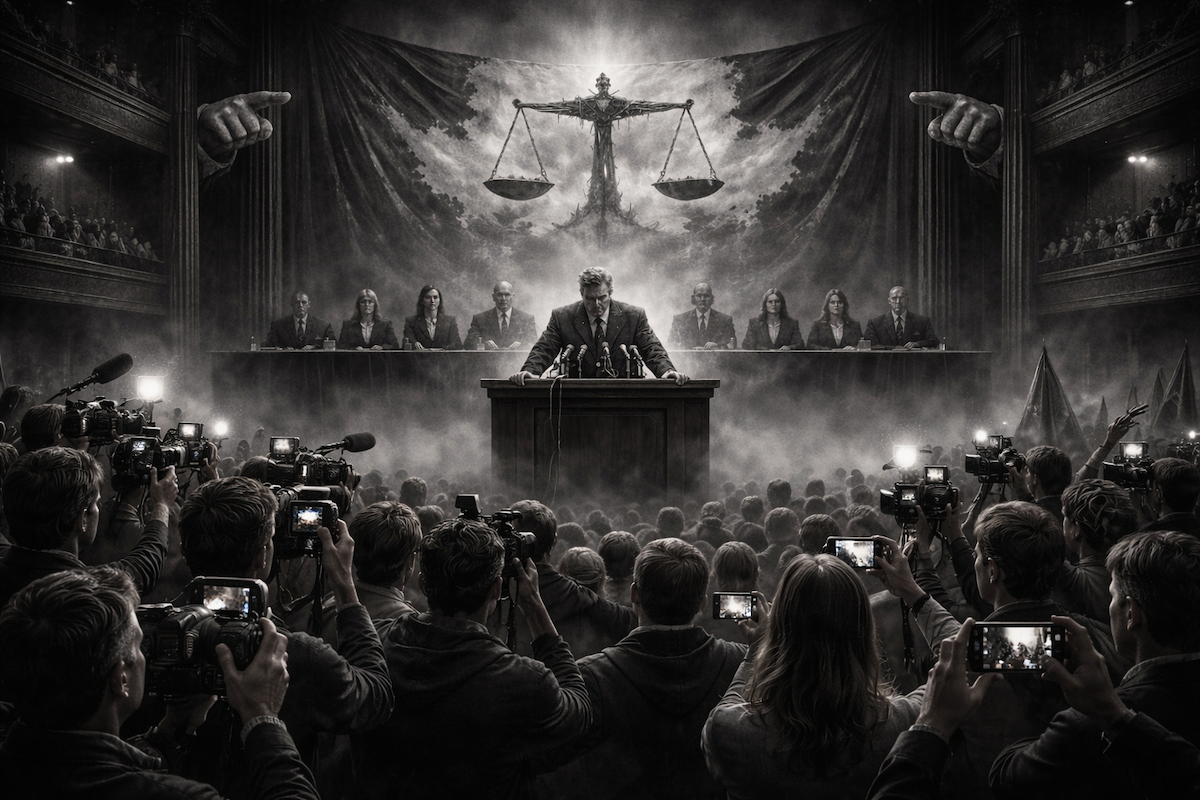
The pragmatic mode of crisis communication was later abandoned — and replaced by the instructive mode of moralization.
The benefit of moralization: morality is never wrong, for it is removed from the concrete situation. At some point the respective position was indeed correct — in the sense of a certain necessity, perhaps also initially capable of gaining approval. But whether something remains correct is decided in later, then new situations…
The world keeps turning, life changes… But moralization elevates the concrete action, which may initially have been right and later may have developed into a mistake… Moralization shifts the action onto a new level, where it is no longer about “concretely right” or “concretely wrong,” but about “generally right” and “generally wrong”; moralization detaches the action from the concrete space-time context. Moralization is taking place on a more or less general level — and it is formulated without alternative.
If an action on the practical level proves to be of little success or even ineffective — which can happen, as said: often we do not know, but decide according to the best knowledge at the time — this is not admitted, but instead one continues on the moral level rather than on the factual level.
A current example: In a democracy, under certain circumstances a party can be delegitimized. That is risky, but possible. But we cannot delegitimize the will of a significant part of the electorate.
We can, on the one hand, look at the support for a certain opposition party and understand the respective dynamic only as support. But then we perhaps do not understand the situation correctly. We have to (at least: should) also ask how much rejection of other parties is contained in that support — and at least this rejection should be taken seriously and turned into policy. That would mean understanding the electorate, even if we reject or even delegitimize the respective opposition party.
But exactly this does not happen.
Only the support is recognized, the rejection is not even addressed — but immediately and almost reflexively stigmatized. And for exactly that reason the respective opposition party becomes ever stronger.
Moralization eventually leads into alarmism and… radicalization.
At the latest then a dynamization between mutual attributions arises — and thus further radicalization. None of the involved actors exits the dynamic — how could they, if precisely by doing so they can “prove” to their own people that they are right.
We could, of course, attribute this to “mechanisms” — societal or social-media-driven — and thereby stylize ourselves as an “innocent” entities — or marginalize our own contributions.
Yet we have, however small the contribution (from our own perspective) may be, made a contribution to the escalation.
A society must and cannot be in agreement — how could it?
But it requires a certain belief that we as a society have a shared future, that we collectively contribute to the future of the commonwealth. Why else, for example, should one pay taxes? Or why else, for example, should one take on voluntary service?
Exactly this “minimal cohesion,” the belief in a shared future or at least a shared purpose, has at least come under pressure, if it is not already “dead”.
Fewer and fewer people believe in it — yet they are instructed ever more loudly and clearly. Cohesion wanes, centrifugal forces grow. With current “left” policies, higher taxes become more likely — while at the same time confidence declines that higher taxes would contribute to any positive version of a “shared future”.
Germany as the “economic locomotive of Europe” (largest economy, until recently world export champion, etc.) is under pressure — THIS is what people understand much better than the presented necessity to restrict ourselves, to reach ambitious climate goals, to become an “inclusive society” and so on. And not only because it reaches and affects people’s wallets, but also and above all because people can understand that if one wants to achieve something, one must also be able to afford it. People see very clearly that EVERYTHING AT ONCE can only be financed on credit and therefore becomes risky.
On the short term, it is important to me what I can pay next week, next month, next year. From the transcendent transformation claims of a government I cannot buy anything — insight into necessity or not.
A mindset that assumes we can achieve transformation goals with a persistently high (or rising) tax burden and without any restriction of the currently existing welfare state must fail, because the currently ongoing transformation means at least in the medium term lower tax revenues AND higher costs.
If we wanted to achieve anything at all, we would have to realize measures from both directions of thinking, for example putting certain segments of the economy under pressure through regulation AND loosening or suspending employment protection. (This is only an example, not a proposal.)
But such a thing does not happen, on the contrary: we transform with the highest conceivable pressure while preserving the maximum conceivable comfort zone, because we do not want to risk an outcry — or, as a concrete party: cannot risk an outcry without risking our own existence.
Anyone who has ever successfully conceived and implemented change knows that ambitious goals cannot or hardly can be achieved if one does not also restrict comfort zones. Anyone familiar with change knows that the outcry will come anyway — one cannot implement change without outcry, the only question is that of a “well-tempered” implementation.
In this respect we can wish that the relevant actors wake up and take measures in both directions of action.
More likely, however, is that they do not wake up but continue to teach a large part of the electorate to be wrong — and that on the other side people continue to hold against it diligently without really (= based on knowledge and experience) knowing better.
One option would be a new force in the center of the political spectrum. This force would have to take measures from both directions: enable innovation and restrict the welfare state without demolishing it; limit migration without curbing necessary migration (but rather enabling necessary/needed migration directly), roll back bureaucracy without otherwise undermining reasonable regulations, etc.
This balancing act is terrible, yet almost impossible, because nowadays there always will be someone who will scrutinize everything. We are late humans, we have grown accustomed to comfort zones — and scrutinizing existing norms has almost become sort of a “national sport”.
But without significant measures it will not work. The question is not so much which concrete measures are exactly effective, but whether there is at all a viable, shared, somehow capable-of-approval vision of the future of our society.
Otherwise the probability rises that we divide ourselves so far that violence becomes an option. For some (keyword: Hanau; keyword: Hammer group; keyword: Magdeburg) violence has long since become an option.
My assumption is that something is wrong with the whole “progressive project”, because it simply cannot succeed so quickly and so extensively. We are human beings, we need time, and changes are always the result of interaction processes. Democracy is not an “ideal”, but it is a widely functioning mode — with in each case high frustration potentials for the somehow weaker side. We have had a quarter century of rather left-leaning politics behind us. Now the tide is turning.
How one, as a member of the progressive side, can deal with this wisely, remains an open question. The answers so far have in any case only made the turning of the tide more likely.