Time and the State of Exception
Foreword
This text is, at best, a kind of “intellectual provocation”—but not with the intent to convert. It is indeed meant to articulate things that tend to get drowned out in the noise of (alleged) inevitabilities: the arduousness of democratic procedures, the value of ambivalence, the danger of “otherwise well-intentioned” coercion.
Anyone reading this text will feel friction here and there. Friction is not a flaw. What’s unfortunate is only if one fears it. We are not living in the wrong system. But we may be living in a system that overburdens itself.
Sometimes, it makes more sense to take a step back rather than to rush ever faster forward—flag raised high, eyes closed.
The Simultaneity of All Times and Its Consequences
We live in an era in which all times seem to occur simultaneously. Past, present, and future collapse into one—tangibly, visibly, clickably. Through films, fantasy, books, events, and digital media, we can immerse ourselves in (almost) any time we choose. The internet instantly delivers any result—without regard for how long it may have taken in history to produce that result or to reach that insight.
With artificial intelligence, this condenses even further: I ask a question and immediately receive an answer that, in the past, might have required years of study—or at least weeks of reading. This coexistence of all times, combined with the compression of knowledge and options, coincides with a global acceleration.
Phases that once lasted centuries are shrinking to decades, then to years, perhaps soon to mere months. Science, technology, and the economy drive one another forward. Innovation cycles shorten, revenue per unit of time increases, energy demand grows. We build more, process more, protect more—this last point we like to believe, especially when it comes to the environment and our children. But whether it is truly so remains, in my view, an open question.
The simultaneous variety of options and the simulation of any epoch also have psychological consequences. Identities have long ceased to be linear and stable—they appear fragmented. A single individual lives in multiple roles, cultures, times, or projects at once. Every decision seems optional, perhaps even reversible. Every affiliation feels “somehow temporary,” possibly “provisional.”
Life thus enters a state of constant reorganization. The individual’s will to shape things overrides commitments. Not least, relationships and children are increasingly treated as projects. (Birth rates worldwide are falling faster and more sharply than recent forecasts had predicted.)
The result is an increased consumption of resources—both material and psychological: ever more individual and refined desires become fulfillable. The question is: does this truly expand our options—as recent interpretations of some currently hotly debated terms suggest—or does it merely refine our demands, over-refine our expectations—and thus, perhaps, lead simply to decadence?
The simultaneity of times, options, and selectable identities may generate not only tension but also… emptiness. A tensioned emptiness—or an empty tension, if you will.
What is no longer embedded insists on being seen.
Example: If the only remaining determining category is the “I,” then the “I” forces itself into the foreground. Self-reflection turns into self-rotation—not only in the all-too-obvious, noisy, narcissistic variety, but especially when the rhetoric stays quiet, appears critical of narcissism and ego, and yet masks nothing other than—overly mindful, overly humble—self-observation or self-rotation.
How to recognize this? When everything revolves solely around the self and nothing else. Or when it ostensibly addresses something else but in truth still revolves around the speaking self.
The loss of linear time does not lead to calm but rather to constant overstrain: every impulse becomes a signal, every moment potentially overloaded with meaning. What used to be a nuance is now played as a solo—loud, isolated, overamplified—because there is no longer a symphony, only my individual film.
This generates a kind of sustained tension that, although felt as tension, transforms—because it becomes a permanent state—into a high-speed form of emptiness. A lot happens—more and more in ever shorter intervals—and yet, somehow, nothing happens at all.
In this kind of “hurried standstill,” we lose our footing.
Without time, there is no framework; without framework, no standard. Without a standard, there is no distinction between important and unimportant. Every moment becomes a stage—and every impulse competes with all others.
A perfect condition not only for narcissistic personalities but for anyone longing for digital attention. The digital realm seems to give us what we want—but not direction.
Freedom without foundation, without coherence, becomes a burden. “Directionless digitality” creates open space—but if “everyone” wants to become an influencer, the whole thing eventually devours itself: what is said or “posted” becomes an end in itself. It’s no longer (or never was) about understanding—but about attention.
Opinion becomes a mere reflex: I have an opinion because I expect a certain effect from it. Not because I have reached a certain perspective and wish to share it, but because that opinion has a desired effect. What unfolds is a kind of ongoing drama: permanent present, action without origin, opinion without context, outrage without cause.
Digitality grants us access—but no hold.
The only thing that seems capable of countering this is a purpose independent of the acting individual. A “why,” possibly shared with others, does not only yield meaning and motivation—it also provides a standard for action. One can assess whether an action contributes to a certain purpose or not—and to what extent.
The question is, I would argue, where this WHY comes from—or how one arrives at it. At minimum, we can distinguish here between an idealistic and a, in some sense, “pragmatic” or even “conservative” perspective.
Idealism and Distant Time
Idealisms are grounded along the timeline in both a distant past and a distant future. As a result, the present shrinks into a mere “space of necessity”—a transit station filled with urgencies. Because something happened “back then” in a way that is now seen as unchangeable and therefore “compelling,” and because something else will inevitably follow from it in the “still distant” future, we must act now.
We must act in this way: by striving for a better future—one that must above all be brought about by us, the people of today—we can avert what would otherwise be inevitable. And so we must act accordingly, so that negative consequences are prevented or the “better version” of the future comes to pass.
Should we encounter skepticism or resistance along the way, it only serves to make the necessity seem even more urgent.
This “blueprint” applies to any “-ism” of the present and recent past. Whether a particular “-ism” appears “right” or “wrong” depends heavily on the prevailing zeitgeist.
Let’s take the example of the ecologically oriented “-ism”: because we, the people of today, may one day be seen as those who knew everything but did too little, we must now increase our efforts—even if it costs us our prosperity and the world as we know it. After all, what is our prosperity compared to the destruction of the planet?
Faced with this seemingly inevitable horizon—because industrialization in the past caused the effects we see today—we must now act quickly and decisively if we want any kind of livable future.
Everything narrows to the moment: it all depends on us. We carry a heavy legacy, but we are also the bearers of the genetic code of the future. We must act here and now.
The possibility that we might come up with future-oriented technologies—ones that could allow us to address the issue not through radical self-denial or a backward leap into a quasi-Protestant valley of lamentation—is simply excluded.
We have, in this new “-ism,” finally found a flag under which we can gather our fragmented and often lonely egos. And we cling to it, because an “-ism” is always bigger than ourselves—especially when we have little else left to bind us together.
Only a fool would dare to notice the parallels: because “back then” things were as the current doctrine declares, and because now “this and that” must be achieved, we must therefore do “this and that” today—executed in the most uncompromising way possible. … We have seen “-isms” in which people were rounded up, interrogated, confronted with absurd accusations, imprisoned, tortured, beaten, or even killed.
Of course, we are far from that today!
I fear, however, that we are only far from it in our current practice. As for the theory—I’m no longer so sure. What I mean is this: Idealism becomes especially dangerous when it distances itself too far from the present moment.
Certainly, we must change something.
But there’s a reason why there is a tension between “progressive” and “conservative” forces. Democracy means that people openly argue—and vote. It does not mean that there are “truer” or “more desirable” opinions.
What you think is your business. Period.
What you do or whom you vote for—that is also your business. Period.
I can present my viewpoint. Period.
You present yours. Period.
Perhaps new insights emerge, opinions shift, election results change. Or not. Period.
Parts of our current social diagnoses—ecological as well as migration-related—risk being presented or asserted in overly generalized ways, generating radicalization potential that applies not only to the core belief but, above all, to the respective counter-reaction as well.
Eighty years of peace seem to have been long enough for us to (once again) imagine extreme consequences—because we believe we are right. Rather than remaining in the (painstaking) mode of traditional democracy.
We have lost tolerance and understanding for that difficulty. We justify our escape from this difficulty with (theoretically generated) necessities. On both sides.
There is no decency left in our culture.
May God help us.
And if there is no God (which is very likely), then it would still be good to behave as if there were one—in order to shield ourselves from undesired consequences.
The Present as a Sealed Moral Imperative
The now is morally charged. The ecological narrative culminates in this: because what happened, happened—and because what will happen must therefore follow—we must now act in such and such a way.
Such sanctification of the present turns deviation into betrayal. The present becomes morally sealed: anyone who dissents becomes a threat.
What was just described for the “ecological narrative” can be expressed in political terms as well—through the hashtag #NeverAgainIsNow: the past admonishes, the future threatens, the present judges.
But does the present truly know better?
Eighty years later, resistance is easy—because it costs nothing. On the contrary, it is even rewarded.
Today, responsibility becomes a duty to act “correctly” and immediately: we must “get it right” here and now—because of the past, and even more so because of the future.
But without giving ourselves some time—to form purpose, to build opinion, to create a shared intention as a framework—it all becomes nothing more than a perpetual lecture.
And in the noise, thinking dies.
The “solution” may lie in detaching ourselves from this temporal pressure and returning to a shared purpose.
Life has no inherent purpose. We give life purpose through our actions. Life itself is not meaningful—but every action can become meaningful.
It is worth acting—precisely because every action can make a difference.
I act because I want to. Not because I have to. And certainly not because I’ve been lectured into it.
Of course, it is worth preserving creation. And of course, preserving the foundations of our existence is more important than whether it “pays off.”
Of course, it is worth safeguarding democracy and protecting it against erosion. But when this protective claim comes wrapped in coercive argumentation, it only paves the way for new monsters—because in the end, we strengthen precisely that which we sought to fight.
For the majority of activists, the following probably applies: they strengthen what they actually wanted to oppose—without seeing the causal relationship. Good intentions do not protect against ill-suited ideas, and certainly not against unintended or unforeseen consequences.
Final Comment
Long before today’s escalation of the situation—somewhere between 2010 and 2015—this perspective was not uncommon among change specialists:
“We won’t be able to go on like this. Sooner or later, we will have to limit the ecological footprint. Hoping for insight is naive. We will need strong regulation and a strong administration.”
In hindsight, it seems as if precisely this approach has since been attempted—with regard to migration, COVID, energy, and other issues.
Of course, some situations do require action. When a threat arises, one must respond. But the question is: does the threat arise because it truly does—or because it is declared to exist?
The psychological mechanism that reacts to a threat doesn’t care whether the threat is real or imagined. It reacts either way.
Idealism increases the farther we move from reality. And so it remains a very relevant question: how much idealism has shaped German politics over the past ten years?
Whether something was a genuine necessity or merely a declared one is something that only the timeline can ultimately determine. But if that necessity has already been overtaken by the “idealistic acceleration of necessity” itself, then meaningful advice becomes expensive—because mistakes have been, and will continue to be, made without anyone realizing it.
Our (barely reflected) mantra: Because something was a certain way in the past, it will therefore be a certain way in the future.
That we need to change something is beyond dispute.
But the rhetorical escalation of idealistic inevitability forces us to implement exactly what X or Y is currently claiming or marketing as a solution.
One might also ask who is getting rich—or already has—off of all this. But again: only a scoundrel would pose such a stupid question. 😉
The fact is that this supposed inevitability liberates us from the—historically not at all absurd and often successful—mode of trial and error.
Instead, we often simply claim to know what is right—and through this very certainty, sometimes make horrific mistakes.
As a result, we come to the right ideas too late, waste resources, and so on.
Idealism has no time.
And that is precisely why idealism is more prone to error than the slower, skeptical, sometimes even resistant mode of innovation that emerges from broader societal conflict and long discussions.
Sometimes, one must create conflict—so that there is something to work on. And I don’t mean this in the somewhat self-evident or vaguely romantic sense of “transformation.” I mean it in the hard, clear sense of preventing mistakes born purely of idealism.
We may have already done enough short-sighted nonsense.
It doesn’t help the planet much if 80 million people (a very small single-digit percentage of the world population) suddenly become idealistic—acting only in one direction, out of submissive self-restraint and self-punishment.
Germans seem all too eager to “get everything right.” Two specifically German spirits unite here: the “culture of remembrance” and a certain, perhaps originally Protestant-tinged, tendency toward idealism. (As a footnote: If you look closely, you’ll find plenty of Protestant-normative echoes in our grand German communication theories.)
The result? If we’ve done so much wrong in history, then we now want to do everything right.
But in doing so, we fail to see that the conditions may have changed—that the world may be different than we like to imagine through our ideals. We gaze at ourselves, all too willingly, in the flattering light we wish to see ourselves in—especially in recent years, under the glow of the “welcome culture” and ecological idealism.
That we might get some things right—but also make new mistakes—is something we don’t yet realize. Not until later. By then, some global market leaderships may have already collapsed—and new ones cannot simply be ordered on demand.
Jörg Heidig
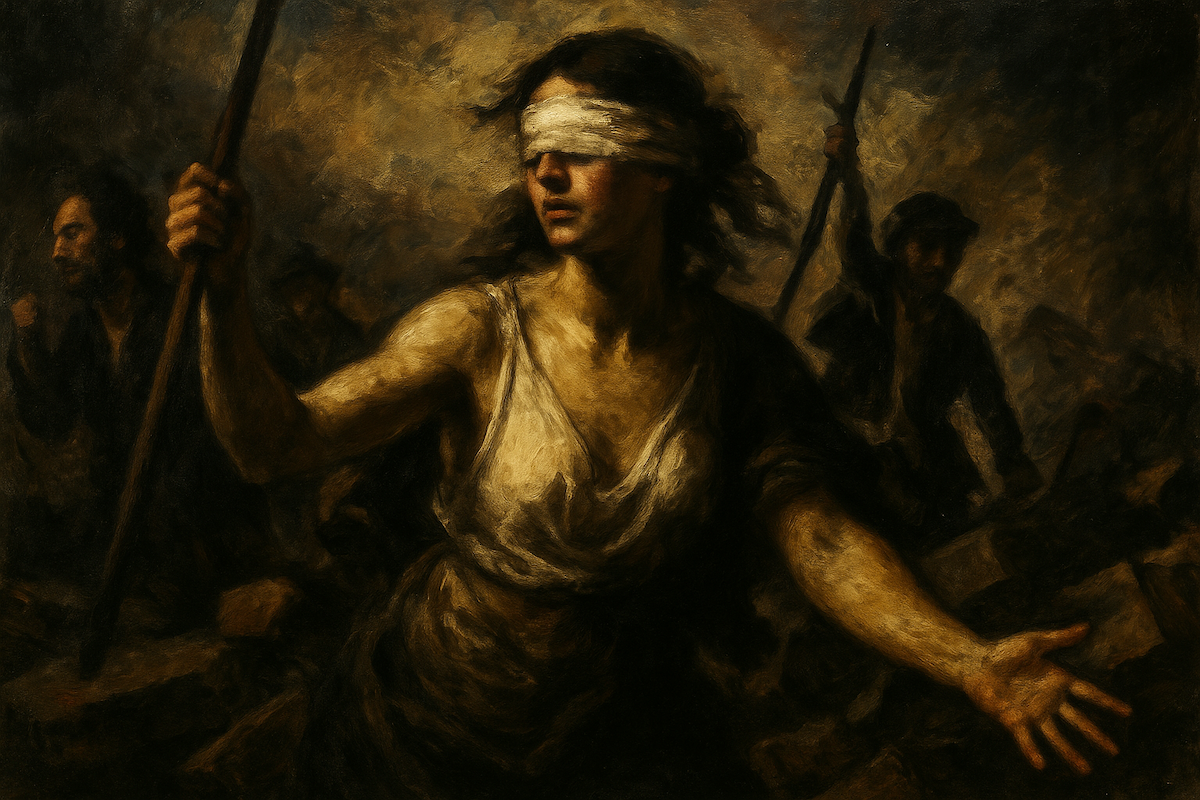
PS: The featured image was created with the help of artificial intelligence.