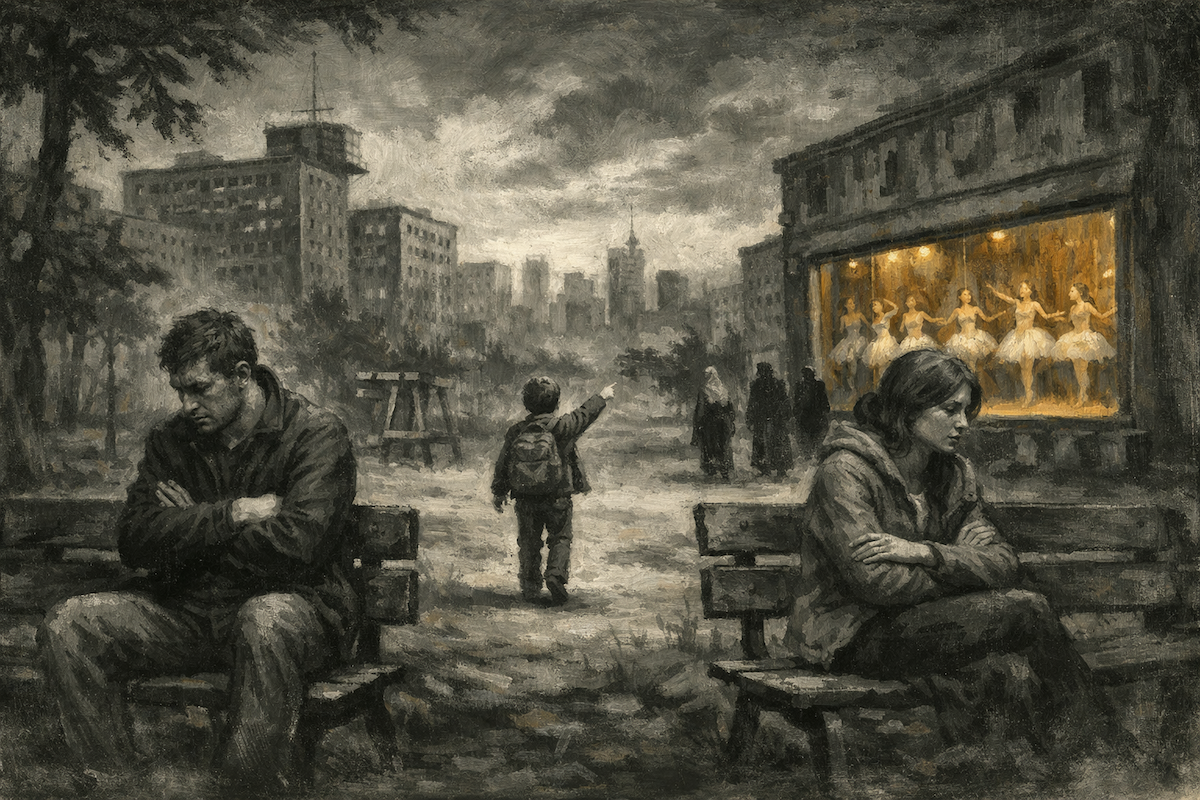
The Sickness Unto Death: On the Monstrosity of Self-Erasure
We are having fewer and fewer children. That is not a new finding. But the development has entered a new phase. We are no longer dealing merely with a stagnant birth rate. We are looking at a downward movement that is accelerating, and that in Lusatia at the latest has long since fallen far below the level a society needs if it is to carry itself into the future by its own strength.
This development can be measured. It is known. And yet it is still usually treated in a somehow superficial way—as a statistical issue, as an economic challenge, as a demographic shift. What is often overlooked is that these figures are the outward sign of a deep transformation whose consequences we yet do not fully understand.
If East Germany were a country, it would have the third-oldest population in the world, after Japan and Italy. And this does not hit the cities and the countryside equally. It hits the countryside much harder.
One example: The city of Dresden and Upper Lusatia—the districts of Bautzen and Görlitz—have, roughly speaking, a comparable population, each a little over half a million. And yet Dresden currently sees around 6,000 births per year, while Upper Lusatia sees only about 3,000. In Dresden, that puts the fertility rate at a little over one child per woman. In Upper Lusatia, it is well below that—so far below, in fact, that the region ranks among those with the lowest birth rates in the world.
Some time ago, children ceased to be something like a more or less self-evident part of family life and became a decision. That shift happened quietly, but it was fundamental. Only a few decades ago, the question was not so much whether one would have children, but at most when, and how many.
Today, having a child is part of a larger life plan. It is embedded in thoughts about one’s own development, one’s own freedom, one’s own future. And of course, people now also ask whether they can afford to have children. That changes not only the decision itself, but the meaning of what is being decided.
A child is then often no longer simply a child. It also becomes an expression of a life plan, an expression of a worldview, an expression of what one believes to be right. There is an enormous emotional and symbolic charge in that shift. The individual child becomes more significant. It is not merely accompanied through life; it is, in a certain sense, shaped.
A child today can easily become a project—part of the parents’ self-realization.
If that strikes you as far-fetched, then please consider this: as of today, more than half of all children growing up in Germany are only children. If you do not believe it, look it up for yourself.
This development is, of course, not intentional. These individual decisions grow out of care, out of a sense of responsibility, out of the desire to do it right. But if I have only one child, and if I want to raise that child “well”, then all my attention is directed toward one single point rather than divided among several. I may want to get it right in that one case. That is precisely why this trend is so powerful. Where several children once grew up alongside one another and with one another, there is now often a constellation in which a single child stands at the center. That child carries expectations, possibilities, hopes—and becomes all the more a screen for projection. The child is protected, encouraged, guided, often more intensively than ever before.
Does that contain a certain excess—too much pressure, too much emotional loading, too much overprotection, too much projection? I would say yes. But please find your own answer. I do not want to put words into your mouth. I do not want to convince you. But I do want to trouble you, as readers, with my point of view.
Our understanding of child-rearing has shifted, and in many respects that was—and often still is—a good thing, because too much authority—authority that is too cold, too distant, perhaps even violent—has consequences that have been studied all too well. But the old authoritarian world has largely disappeared, or at least been discredited—not entirely, but to a great extent, which is exactly why the cases of violence or cold conformist pressure that still come to light today seem all the more disturbing. The idea that first took the place of that old world was the idea of meeting the child as an equal—a counter-model to blind authority, to an upbringing that molds human beings without asking them.
And yet, in its further development, that often turned into something else: a form of withdrawal from upbringing that no longer merely emphasizes equality, respect, and explanation, but avoids setting limits altogether. Authoritarian parenting became parenting at eye level—and later, first in some cases and then with increasing frequency, it became something like the submission of parents to their children.
When these two developments come together—the child as project, and the retreat from limits through submission to the child—they produce a constellation with new, and until recently unseen, consequences. The child grows up in a space that is no longer merely strongly oriented toward its needs. In the best case, the child experiences itself as heard, significant. Many will welcome that, and up to that point we are still talking about the much-invoked ideal of meeting the child as an equal. But a few steps further down that same path, one often finds that the limits through which empathy develops have disappeared. Out of the submission of parents to their children arise assumptions, habits, and expectations that until quite recently were unfamiliar to us.
These new assumptions do not shape only the individual. They shape society as well. They shape our relationship to authority, to obligation, to responsibility. They shape the way relationships themselves are formed. And it is precisely here that the dynamic intensifies, because at the same time we are witnessing a growing instability in relationships.
Many relationships today seem to have a kind of half-life. When a relationship no longer holds, it is ended. That is understandable. Often it is even necessary. As long as only the two adults involved are affected, that is hard enough, but it remains a conflict between adults.
The situation changes as soon as children are involved.
Children cannot choose the constellation into which they are born. They cannot choose how their parents relate to one another. They depend on the adults around them to conduct their conflicts in a way that does not destroy the child’s bond to either parent. And that is precisely what often fails to happen.
What emerges then is usually not open conflict, but a lasting tension—sometimes stronger, sometimes weaker. One parent speaks negatively about the other. Sometimes openly, sometimes subtly, sometimes in direct remarks, sometimes only in tone. For adults, that may serve as an outlet, an expression of hurt, an attempt to process what happened. For children, it is something else.
Children then are caught in a double-bind. Both parents are part of their identity. When one parent demeans the other, it is not only a person being criticized. Indirectly, a part of the child is being attacked as well. The child cannot escape that situation. It has to find some way of dealing with it.
One possible response is to conceal or distort information. The child tells one parent what that parent wants to hear, and tells the other something different. Out of that emerges not only tactical behavior—and often enough the ability to lie—but also inner confusion.
Another possible response is withdrawal. Communication is reduced. Closeness is avoided in order to escape the tension.
A third possibility is to enter the conflict oneself—as an ally, as a mediator, or as someone who learns to use the situation.
In none of these cases we do get stable development. What we get is adaptation to contradiction.
And if such constellations apply in the majority of cases, then the very quality of attachment changes. Attachment is no longer experienced by most people as something stable, but as something changeable, uncertain, dependent on moods and circumstances. The child grows up not only as an only child, but often also as a child of separation, moving back and forth between worlds that do not fit together. In that way, the child is thrown back onto itself—and that, among other things, makes narcissistic modes of behavior more likely.
What we often see, then, is the overlap of two developments: isolation through low birth rates, and fragmentation through unstable parental relationships. These two developments reinforce each other. Where siblings, stable structures, and clear roles once provided orientation, there is now more often a situation in which the child, as I said, is thrown back upon itself—while at the same time carrying a high emotional charge.
The result is not freedom in the full sense of the word, but a form of unboundedness, and that is deeply ambivalent. It opens up possibilities, but it also removes stability.
This development cannot be understood if it is only criticized. It is also the result of a liberation. Turning away from authoritarian, violent, or constricting structures was necessary. The expansion of individual room for action was progress. The possibility of leaving destructive relationships is not a loss. It means a liberation.
But every shift produces new assumptions, new habits of feeling and behaving that begin to seem self-evident. And these, in turn, have consequences. We have not only overcome dysfunctional family structures. At the same time, we have also weakened the model of stable attachment as such—not completely, but noticeably. And that creates new forms of strain.
The likelihood of trauma does not disappear. It only shifts: Less open violence, more silent inner fracture. Less rigid order, more diffuse uncertainty. Less external limitation, more inner disorientation.
This experience fits into a larger social picture. A society in which children have become a decision, in which the individual child more often becomes a “project”, in which limits are reduced and relationships become more unstable, produces a particular form of selfhood. This self is sensitive, attentive, reflective—but it is also fragile. It is strongly turned in upon itself because it has grown up as an only child and may have learned that reliability is never guaranteed.
At the same time, a cultural superstructure arises that accompanies and reinforces this development. In many fields, a form of morality moves to the foreground that is strongly oriented toward individual sensitivity. It explains, instructs, differentiates. It tells us what must not be. But it says very little about what is supposed to bind us together.
Out of this constellation emerges a peculiar form of sadness. Not dramatic sadness. But rather a quiet, diffuse sadness—a sadness without a clear object. It arises where possibilities are many, but obligations are weak. Where the individual stands at the center, but that very center is itself unstable.
This sadness is often covered—by activity, by self-display on social media, by attitude, by moral positioning. It seldom expresses itself directly, but it is palpable. You can feel it in how little faith people still have in permanence. In how quickly relationships are called into question. In how cautious people have become when it comes to attachment.
A society that develops in this way also changes its relationship to itself. It becomes more cautious, more conflict-averse, less willing to take risks. It orients itself more toward preserving individual quality of life than toward defending those structures that bind people together and make demands on them. In the end, such a society consists above all of isolated individuals who live alone and come together only when it suits them—and usually only briefly, and only for a particular occasion.
At the same time, counter-movements emerge. But these counter-movements do not arise on the level of the actual problem. They tend instead to come wrapped in a diffuse unease and in political statements. But the underlying problem is that what earlier generations took for granted is disappearing, and that we, living today, no longer have any shared picture of the future. We no longer quietly assume, together and without needing to say it, that our children will one day live in better conditions than we do.
The result is that, on the political level, we are surrounded by a certain amount of noise, while the real cause, the real unease, goes unaddressed. On the one side, every form of boundary-drawing is turned into a moral problem—that is the radical left position. On the other side, we hear the claim that there is nothing left worth defending anyway—that is the radical right position. In the tension between these two positions, a stance emerges that can best be described as resigned cynicism.
If one brings all of these developments together—the shift of the desire for children into the realm of individual choice, the symbolic overloading of the individual child as a “project”, the transformation of child-rearing styles, the growing instability of relationships and the resulting isolation of children, the expansion of individual freedom of action alongside a decline in binding commitments, and the fading of the hope that once bound us together, namely that the next generation would live under better conditions than we do—then what emerges is a picture that can indeed be described as a form of decline or decadence—not merely in a moral sense, but as a description of a condition in which a society slowly loses the very preconditions of its own existence.
This development is not a sudden rupture. It is a process. At first, it consists of understandable decisions, of well-intentioned changes, of real progress. For the first thirty years after birth rates decline, one hardly sees it. We may begin to notice it only when the number of job applicants starts to decrease—roughly twenty years after the birth decline. But we really realize it only when an already diminished cohort of people in their thirties then goes on to have even fewer children.
But by then it is already too late. To put it bluntly: the last moment at which anything could still have been done to change demographic development was when Helmut Kohl was still Chancellor of Germany. Developments of this kind are hard to detect and hard to forecast—harder still to talk about—and harder by far to correct.
In this shift lies what one might call a social “sickness unto death”—not as a dramatic collapse, but as a condition in which a society goes on functioning even as its foundations are changing. Society continues to live on, but it is moving away from its own future.
Perhaps the real challenge is not to stop this development, but to see it clearly enough to understand what is happening at all—without indulging the illusion that one could simply return to some earlier state, and without clinging to the at-best social-romantic assumption that all of this could somehow be solved with a little more migration.
Every age produces its own contradictions—and often enough its own new monsters. One could describe this as a “sickness unto death”, as the monstrosity of a society erasing itself by its own hand. Because it is so difficult to imagine, we do not confront it directly. We approach it, if at all, only in fragments.
If we truly wanted to think seriously about the future, we would have three options.
First, we could manage our own decline conservatively. We would accept that there will be fewer of us in the future. Over time, we would close villages. We would limit migration and try above all to select those who fit us and who can help secure our future.
Second, we could throw ourselves headlong into what some among us, far too optimistically, call transformation. But that would entail conflicts that could hardly be managed by peaceful means alone. In my view, it is a romantic illusion to believe that large-scale migration from cultural contexts shaped by different conflict patterns can be integrated quickly. Something like that takes time. It takes generations. And for the mode “slowly, over generations”, it is already too late. So either we shrink—with the corresponding consequences, including more conservative electoral outcomes—or we get more conflict in the streets, in schools, on trains, everywhere.
Third, we could have the courage to develop a genuinely viable vision of how and why we should still exist as a society even around the year 2100—and what would be necessary for that. In my view, that would amount to a combination of the first and second options. Clearly, we will not suddenly start having more children tomorrow. We are, and will remain, a “late society”. But perhaps there is still a middle path between “managing our decline well” and “throwing ourselves into transformation at full force.” That path would be neither backward-looking nor intoxicated by the rhetoric of transformation. It would be pragmatic. It would focus on what can actually be done. Of course it would not simply let in too many people, but neither would it be defined by rejection of migration. It would gradually become a country of immigration without overburdening its own infrastructure through a naïve cult of “welcoming”. It would be neither idealistic nor reflexively opposed to everything.
But in Germany, as so often, one tends either to be enthusiastic and convinced that the whole world must be turned upside down—or to be against it, and in that opposition again enthusiastic in its own way about overturning everything.