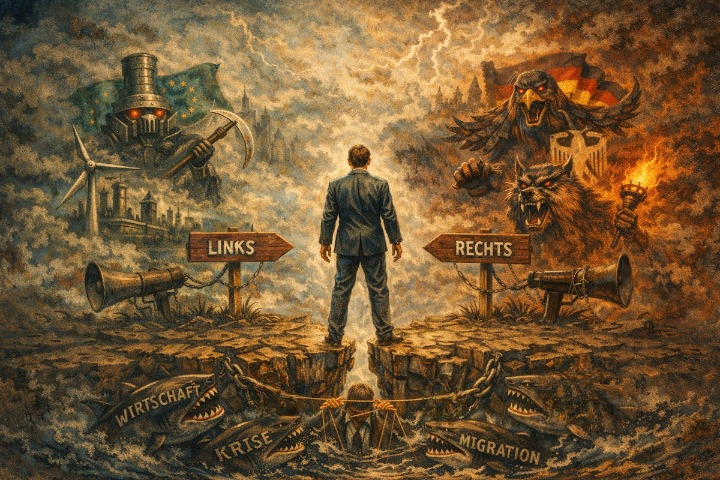
The Paradox of No Alternative
We as human beings probably have no real sense of balance—at least not within the framework of a society. We only notice limits once we are at them or beyond them. And even then, we run the risk that the situation first has to escalate properly before we are prepared to make significant changes. Deep structural changes such as the “Agenda 2010” back then are probably much more difficult to implement today than they were at the time. How, please, are we supposed to “de-bureaucratize” ourselves, for example? Then as now, the rule applies: changes are shaped moving forward—and all too often only understood and accepted in retrospect. This last sentence is explicitly not a justification for the overly persuasive tendencies of the past ten years.
The list of potential lectures is long: beginning with the then Federal Chancellor’s “We can do this!” and the (frequent) claim that certain measures were “without alternative,” continuing through the ugly controversies during the Corona period, all the way to “19 degrees in the living room” or “then just use washcloths,” or something along those lines… Not to mention the pathos and self-righteousness with which entire industries were shut down or placed under existential pressure—almost as if such measures were entirely self-evident.
Did we really anticipate what it means to shut down the nuclear industry AND put the automotive industry under pressure AND further unleash regulatory zeal at the EU level? Were we truly aware of the consequences of that “We can do this!”? And did we really understand what it means to do all of this at the same time, without anyone having a blueprint for what the consequences would be?
We did not, for example, ask ourselves which products we could develop in order to become world market leaders in the technologies necessary for climate change mitigation; instead, we asked how we ourselves could decarbonize as quickly as possible, reduce energy consumption, abolish fuel engines, and so on. We switched off our nuclear power plants while the world is desperate for energy. We put the automotive industry under pressure while the global market has changed and while, in China, people have evidently asked themselves quite successfully which products they should flood the world market with in order to be successful in the coming decades. From export world champion to an almost “eco-pietistic vale of lamentation” in just a few years—while at the same time continuing an expansive social policy. Just ask yourself with which taxes we want to finance our social system if we put key industries under pressure at such a pace. After all, we are now a blueprint for how things can also turn out; we are a damn laboratory.
Yet politically we still behave as if our economy were doing well. We are still distributing billions—which we no longer have, but are borrowing. If we wanted to have such billions in the future, we might have to ask ourselves different, tougher questions. But we do not. For the time being, we simply continue. Have you decided to be part of an experiment?
At the same time, change cannot be achieved without a certain “well-tempered cruelty.” Normally, balance in a democracy functions via election results. Normally.
However, with the so-called “firewall,” the democratic correction mechanism is suspended. There is only “left” or “grand coalition”—and “grand coalition,” in the eyes of a growing number of people, is not very far from the left. At least that is what many will think when they look at what remains of Merz’s goals and priorities so far. It seems as if the currently present “political class” as a whole is not capable of delivering appropriate (= electable) answers.
Let us place ourselves for a moment in the 1960s of the last century—a time when some of the young people of that era asked their parents: “What did you actually do before May 8, 1945?” Of the millions of party members, somehow none were left—or they were, but one simply did not talk about it much. Some of the young people back then had an idea: something like Auschwitz should never again be possible. Let us henceforth raise children in such a way that no one will ever simply “function” again. This agenda was, in retrospect, quite effective. We live in a society in which it is very much possible to say no, not to participate, in which minority rights apply, in which hardly anyone would simply go to war without thinking about it.
Is that a good thing? Viewed solely against the historical background: probably yes. If young people today had to act under the conditions against which their grandparents once believed they had to rebel—well, who would not agree?
But times change. And: eighty years later, “resistance” is quite easy. Let us first note this: back then, people imagined a different society—and they did a great deal to ensure that something changed. And let us say: they succeeded.
Social developments are the results of interactions: we talk and try something out. If what we try is successful, we will probably repeat it in similar situations. If our actions remain successful, they become patterns, later habits—and much later still, the pattern, the approach, the associated organizational form somehow becomes “self-evident”—it becomes the “property of the group.” When times and problems change, new answers or patterns of action must again be found. Perhaps younger people see things differently than older ones—an all-too-classical conflict pattern. In any case, someone comes along, questions the current status quo, tries something out, and believes they know better or can do better. Conflicts arise—and depending on whether and how successful the newcomers are, whether they achieve approval or/and can build power, the situation changes.
The world is always in flux, sometimes faster, sometimes slower. There are always conflicts, sometimes more, sometimes fewer. The important insight is the following: each time, over the course of time, a series of new self-evidences emerges that are later defended when “things start up again.” The process of change is always present, but there are phases of stability—and then again moments that (often only in retrospect) become turning points. Just as a side note: one cannot simply proclaim a “turning of the times”—certainly not if one then essentially continues as before.
In their youth, people form something like “basic lines of thinking.” These basic lines can consist of values, manners, or even just simple notions of quantities and habits (“When I was young, there weren’t as many cars as there are today.” or “We managed without mobile phones too; we simply rode our bicycles over to our friends’ places and rang the bell.”). One never gets rid of these basic lines later on—they shape thinking and ensure that relearning or adaptation is hardly possible without—external or/and internal—conflicts. The children of those people who questioned their parents’ generation in the 1960s, in turn, considered entirely different things to be self-evident than their parents—and compared to previous generations, they were also able to do so more or less unchallenged. And so on.
Our present-day (Western) world cannot be understood without acknowledging an (extremely) strong individualization: I can, as an individual, at any time position myself in relation to prevailing values and norms and express my individual claims, thoughts, peculiarities, expectations, and so on, without being discriminated against for it—at least largely or to the greatest possible extent. However, there is also much to suggest that this is not only an (extremely) strong individualization, but also an almost abrupt increase in narcissistic patterns of behavior.
Many of the people who set the tone today have hardly seen any other self-evidences than those that already enable a questioning of existing norms—yet they still relate to precisely these self-evidences in a manner as if there were still something on every corner today that would have to be met with a revolution, and that could only be removed by fighting it. Some even act as if the country were full of narrow-minded big capitalists or eternal Nazis.
From a liberation of the individual from the chains of traditional norms, within a few decades emerged the right to question. Later, from the right to question grew a certain virtue of scrutinizing, all the way to liberation from any normative covering—and later still to the iconization of ever new minorities as an expression of rights in a free society.
There is something about it that feels as if today’s revolutionaries are dancing with themselves. The reason for the revolution has long since disappeared—the old, nasty, authoritarian reason. New reasons have been sought—new “-isms” under which today’s overly individualized identities can be united. What one does not notice, however, is that one has already been in the majority for many years, that one has already changed the country considerably and ultimately put it under pressure, until a counterreaction has grown. We have had around 25 rather “left” years behind us. And the world has, as said, changed.
One continues to dance, loudly calling out that we must restrict ourselves—while at the same time claiming, almost self-evidently, all those tax-financed dream castles that were created thanks to the high tax revenues during the decades in which things went more or less well. But if the restrictions that have been caused put the economy under pressure to such an extent as has happened at the latest under the “traffic-light coalition” (Social Democrats (red), Liberals (yellow), and Greens) then there are tendentially fewer taxes and thus also less money for the many lamps that make the (idealistic) “magic forest” glow. “Oh nonsense, anyone who says something like that is surely close to the AfD, let’s keep dancing.” — “Yes, right, the guy who says that sounds like my dad’s cleaning lady, she’s always complaining. Let’s dance.”
Tolerance, it seems to me, lives better with a bit of anonymity than with the compulsion to applaud every further differentiating minority definition. Especially since the word “minority” really sounds unpleasant. Can’t you just do what you want? Do I really have to know what you prefer or don’t like? Do I have to clap for that as well? Actually lived inclusion is above all a practical question; something that takes work and, when it functions, is simply lived everyday life and produces no heroes. It does not require flags and no demonstrations. Flags and demonstrations may once have been needed—in those narrow-minded or stuffy or authoritarian or perhaps hostile times. Perhaps you leave your flags at home and simply live—and do not lecture half the world on how to live and what to think.
The matter rather quickly tipped from a liberation from coercion into a duty to applaud every further differentiation. As I said, we as a society probably have no sense of balance.
Hardly any genuine Islamist shakes your queer little hands—because before doing so, he asks himself where exactly and in which darknesses you may already have had your fingers. “Queers for Palestine” would probably survive exactly as long as it takes them to enter Gaza; after that, they would have a survival probability of a few minutes until they are thrown from the next high-rise building (if there is still a high-rise standing). At an anti-whatever demonstration in Berlin, you might walk in the same direction, perhaps your glances briefly meet. But in lived everyday life on some Max-Müller-Street somewhere in a state or federal capital, when it comes to some child conflict in a daycare center or elementary school, there is nothing left of the shared ANTI-WHATEVER; there, the respective lived understandings of tolerance—or indeed understandings of intolerance—collide head-on.
We are getting more conflicts instead of fewer.
Real integration is quiet, practical, and anonymous. Everything else is merely the demonstrative, symbolic noise we make when we can no longer get something done. Best example: “We can do this!” We have achieved nothing at all. It was merely a damn authoritarian assertion without even the slightest effort to prepare the country for what this would actually mean in practice.
Of course there are paths. But these paths fail because of our bureaucracy—we invite people to come here and then let them starve on the long arm of bureaucracy. Functioning paths have limits, set norms, make distinctions, welcome people, but do not succumb to them—and much more.
A society is always based, especially with regard to the question of what it can afford, on the achievements of its members. It is completely normal to make a contribution—and this also applies when younger or other new members question the self-evidences of older and more established members. The scope for shaping the present time is based not only, but very substantially, on the achievements of people with values different from those currently prevailing. This is accompanied by conflicts.
But what happens if the people who currently set the tone put so much pressure on this mechanism that the ability to pay high taxes declines? In my view—and as I have said—this has been the case at the latest during the years of the so-called “traffic-light government”, and it appears to be continuing under Friedrich Merz. What the Greens did to the SPD (Social Democrats) during the “traffic-light” period, the SPD is now doing to the CDU (Christian Democrats). The smaller coalition partner is stronger. And standing at the edge of the field is the AfD, watching—and becoming ever stronger.
That the people who pay high taxes and the people who distribute those taxes are not the same persons—well, that is probably the case in a democracy, and that is probably a good thing. But that those who can change the rules and distribute the taxes put those who generate them under such pressure, as the “traffic-light“ coalition has done, may at least have put the shared “social contract” (we all somehow contribute to a functioning commonwealth) under pressure, if not called it into question. At the very least, the hope that the next generation will one day be better off than the previous one has all but vanished.
The citizen (= the voter) has fine antennas for which concepts are appropriate to the current challenges and which are not. The citizen (= the voter) votes accordingly. Recently, however, examples have been accumulating in which the will of the voters is ignored insofar as a particular party is excluded.
Of course one must think about dangers to democracy. But then one would at least also have to ask what the will of the voters might mean—and respond to it. But that is precisely what does not happen. With the general rejection of the party in question, one also rejects the will of the voters concerned. And therein lies the fundamental error.
One should think very carefully about whether one wants to delegitimize a party. That might well be possible. But delegitimizing the entire associated will of the voters is not provided for in a democracy. One may have something against a party. But one should nevertheless pay attention to the will of the voters and ask what that will means. Friedrich Merz attempted this, but he failed and has not attempted it again since.
In a democracy, one can act against a party, but not against the will of the voters—at least not in the long run. If one acts against both, one probably strengthens resentment on the voter side. And if, at the end of the broom, the party one actually intended to oppose stands there as the last alternative (without ever having had to provide any significant proof of competence), then one may well have made the “monster” one believes oneself to be fighting truly strong in the first place.
One will, of course, only realize this in retrospect. I am writing this in the hope that it will not then be too late.
The ghastly schoolmasterly lecturing with which one currently attacks actually existing problems (the economy, migration, etc.), and with which certain things have been and continue to be presented as “without alternative,” in any case does not produce the intended insight among growing parts of the electorate—because after the “insight” the problems are still there—but instead, just as unintentionally as it is significantly, strengthens the forces one claims to want to fight.
“Lack of alternatives” and the success of the “Alternative” condition one another. Anyone who does not see this will possibly (I would like to say: probably) be overtaken by history.
One can, of course, also see the matter differently: the economic problems are not really “problems,” but symptoms of a necessary transformation process. And migration is certainly not the problem either, because we somehow have to take care of the future of this country—and because the birth rate is what it is. So where would we get without migration? Besides, only those come who can imagine living in a Western society.
Well then. But who is supposed to pay the taxes in the future that are necessary to shape the “transformation process”? That does not happen quickly. Inventive spirit cannot be ordered. Inventive spirit arises, it grows. One needs a certain optimism for that. One has to want to perform. This country has strengths that we are currently discrediting, putting under pressure, declaring unpopular—and the fatal thing is: significant parts of the younger generation believe this.
At present, there are above all “transfer discourses,” that is, questions of which groups receive how much redistribution. But redistribution is only possible if one has a capable net base. If, however, one puts precisely the net taxpayers under high pressure for ecological or redistributive reasons—well then: take a calculator and find the error.
And have you ever asked yourself what a country would have to look like and how it would have to behave in order to be attractive to migrants? That we should and must help people with reasons for flight is beyond question. But we can neither save the whole world, nor does flight generally exist without the option of return. Where does the idea come from that asylum must be conceived without return? And where does the idea come from that one cannot place any demands on migrants?
Where does the norm—popular not only among journalists—come from of speaking of refugees only as “the displaced”? You can call the people in question whatever you like, and of course language shapes our understanding of reality, but why does it have to come across so “booming,” and why must I, although I worked in the field for years and thus believe I know what I am talking about, be lectured by students regarding my choice of words?
We undoubtedly need migrants—but also and above all those who fit in with us, who want to work here and stay. For this, we would at least have to distinguish between refugees and migrants—but no, the sociologically charged language supervision instructs us that one must not do precisely this, because it would be racist or some other thing deemed undesirable this year. I still do not understand the reasons for this to this day, although, as I said, I have spent a significant part of my professional life and my voluntary engagement dealing precisely with this.
Speaking of welcoming culture: we bring people here by promising them something. Then they come, and then we let them starve on the long arm of German bureaucracy. Extremely long and bureaucratic—and above all, with regard to prospects of success, often uncertain—procedures for recognizing professional qualifications, even longer procedures for recognizing foreign refugees, brutally complicated norms regarding the language level required to take up employment, combined with completely inappropriate performance levels in language courses and examinations: speaking at level B1 and being able to prove level B1 are, in many cases, entirely different things.
Time to change something? No. It first has to get much worse. A people of 80 million can endure quite a bit. How much will upcoming elections show. One should then not complain that things are the way they are without reflecting on one’s own contribution to the situation.
If I am not entirely mistaken with this analysis, then this is not a crisis of democracy, but a crisis of the political class. As a society, for decades we have maintained or afforded ourselves a group of people who take care of politics for us. These people had time to develop self-evidences that now no longer help to respond appropriately to the current challenges.
From this perspective, Donald Trump is simply a phenomenon made possible by the situation and the inadequacy of the strategies of action. One can, of course, lament this—but better ideas or more appropriate strategies do not emerge from lamentation. That is precisely what it is about: adequate answers and ideas. We need people who are capable, in view of the given situation, of finding appropriate and future-oriented answers.
Whether the “Alternative” is actually one does not even come up for discussion. So far, the people in question have usually not even been allowed near the possibility of proving their competence. If one looks at Donald Trump pragmatically, he is by no means as unsuccessful as he is often portrayed.
Independently of parties, there is the will of the voters as such, and that was not difficult to read in February 2025: the economy and migration. But with the current grand coalition, the economy and migration are not really subject to influence, because neither the CDU nor the SPD will admit that they made significant mistakes in the past. But they did.
And solely in order to establish this and to enable something different, there will need to be a change—either toward the AfD, which many regard as undesirable or even unbearable, or toward a new force in the center that can shape policy without being driven along by a coalition partner.
If only it were that simple…
It is not to be expected in the foreseeable future that a party will be able to govern without coalition partners. The existing firewall logic forces the respectively strongest party to cooperate with smaller parties. Recent experience shows that the smaller partners are the more powerful ones. In the case of the traffic-light coalition, this does not apply to the FDP, but it does apply to the Greens; and in the case of the current grand coalition, it likely applies to the SPD.
When I say such things, I often hear that it is the goal of the AfD to destroy the CDU, and that this would occur if, for example, the CDU were to get the idea of forming a coalition with the AfD. But what happens if the firewall holds? Then the AfD becomes ever stronger. A situation without a way out? By no means. It is what it is, and life goes on. The CDU will understand that the “Merkel era” is over and that it is time to pursue a new, more conservative, essentially “more right-wing” policy. Then the current grand coalition will break apart, and there will be new elections. Later, one would have to form a coalition with the AfD—and would have to drop the demonizations. Many do not wish for this; even more consider it a catastrophe. Others would say: finally.
Democracy is risky. But: Italy has not burned down either. Or a “new force in the center” could form, presumably with a limited half-life (see France).
With this text, I articulate possible reactions to the current situation. I neither want to be right with it, nor does one have to follow my considerations. What you think and whom you vote for is entirely your own business. However, I would like to invite you to ask yourself to what extent your own assumptions and prognoses are more “realistic” or more “idealistic.” Theories are meant to describe and explain and to enable prognoses. If I may wish for one thing, then that you ask yourself this question: which approaches have so far tended to lead to later accurate prognoses, and which less so?
Whether there really is something we have to be afraid of? I do not believe so. I consider it an ignorance of history to regard the AfD as a whole as a reincarnation of the National Socialists. In my view, the AfD is above all understandable as a reaction to the current situation.
If you are of the opinion that this perspective is wrong, I do not intend to tamper with your testimony. But I would like to suggest that you ask yourself which actions bring about the popularization of the AfD. Clearly, a part of the population—especially in the East—stands on the right. But between the proportion of those who “clearly stand on the right” (for example, in Eastern Saxony for some time now around 20 percent) and the election result of the party in question (in Eastern Saxony we are talking about 50 percent and more), there is a gap of around 30 percent. In my view, this gap is not to be explained by a more or less sudden spontaneous radicalization, but rather by “resistance to pressure of persuasion.” If this is not far-fetched, then the situation could indeed be addressed by a change in policy, instead of continuing as before and regarding growing parts of the electorate as right-wing extremist.
In my view, it is always an interaction process—until one side “wins” and comes into a position to “categorize” the possible reactions and to “control” them with its own interpretation. That is initially quite normal. That one has, this year, with the firewall rhetoric, only truly strengthened the counterreaction, however, does not occur to anyone. One wants a hazard-free comfort zone around one’s own interpretation of history and the current situation. But there is no hazard-free comfort zone—certainly not in view of the current global and budgetary situation. The next elections are coming, and one should be prepared for them.