The Arrogance of Certainty
The “German democratic problem,” which is particularly visible in eastern Germany, is not so much rooted in the interaction between the two currently observable “poles of opinion” as such.
First, a brief attempt to describe that interaction: “moralizing” on the one side and the “counter-reaction” on the other—or, put differently, the increasing questioning of roughly 25 years of “rather left-leaning,” or at least grand coalition (GroKo), policies by a right-wing counter-movement, and the reaction of large parts of the political spectrum in the form of the so-called firewall—“moralizing” included.
Yet moralizing alone cannot be the issue; such a claim would be inappropriate, because morality underlies many things—value systems, traditions, laws.
We hold certain moral principles to be correct. But over time, our ideas of what is “correct” change. There are always competing views—and therefore conflicts. In a democratic society, this is entirely normal.
The “German democratic problem” begins where some participants become overly certain that they are right. But even that, in itself, would not yet make the situation insoluble: one must first be certain of one’s position in order to represent it, and sometimes conflicts must be created in order to have something to work through. Without conflict, there is no development.
But what happens when one is so certain of one’s own perspective that one no longer considers it merely right or more correct, but absolutely correct? And what happens when one then also believes that one has a historically justified right to consider one’s own theories more historically accurate than other perspectives?
Only a fool would not be reminded here of something he or she has seen before. 😉
In the long run, one will probably not be right with absolute claims, because maintaining the absolute status of one’s own perspective comes at the price of rigidifying the system—and by doing so, one creates the ideal breeding ground for the other side to eventually “march through” all the more forcefully—albeit later, and with undesirable, perhaps even dreadful side effects and consequences.
In the short term, however, one certainly provides “enlightenment.” 😉
The “historically justified” line of argument assumes that if we apply an overly “simple” understanding of democracy (whoever has the majority wins and governs), we risk history repeating itself (“Never again is now”). Therefore, we must erect a “firewall” to keep the “gates of hell” closed. The historical arguments are thus, as mentioned, treated as absolute.
Perhaps the most significant moment for the current German government in this context occurred about a month before the last federal election: in the week marking the 80th anniversary of the liberation of Auschwitz, Friedrich Merz attempted to initiate a vote on migration together with the AfD. The sharpest criticism claimed that this would open the gates of hell. The Bundestag at the time “sparked” to such an extent that the later Chancellor Merz has not attempted anything similar since.
The firewall holds—and because it holds, the AfD continues to grow stronger without having to do very much itself.
The accusation that politicians argue in a “moralizing” way is, one might remark somewhat pointedly, essentially trivial. In some areas—such as jurisprudence or climate research—this is precisely at the core of the matter. Anyone who reflects on norms, values, and justice inevitably produces conclusions that are in some sense “moral,” that is, relevant to action in terms of values or the establishment of (new) norms. Firm commitment—or “activism”—is not an accident here, but a necessary part of the process.
Thus, the mere accusation of moralizing does not really get us very far. Moral judgments are part of human action. When someone condemns racism, for example, they act on the basis of established norms. If racism occurs, it is good that someone calls it out.
What many forget, however, is this: such norms emerged from conflicts—and can remain objects of conflict or even give rise to new ones, for instance when one generation was satisfied with the absence of violence, while later generations pushed their demands much further.
At some point—in recent German history, after acts beyond imagination—there was agreement on these norms… and significant parts of society consented by following them. In this sense, truth initially emerges through conflict and later through consent, or through what might be called “tolerant acceptance” on the part of the population.
The real problem in today’s dynamics of moralization—cancel culture being just one easily recognizable example—lies elsewhere: not in activism as such, not in moral judgments as such, but in the arrogance of certainty—in the overconfidence of judgments, in the one-sided absolutization of one’s own perspective, and in the almost self-evident delegitimization of the opposing side.
It becomes problematic when individual actors claim a kind of “final” authority over the interpretation of moral concepts—such as what exactly constitutes “racism,” “sexism,” or “discrimination.” When such terms are no longer understood as subjects of conflict but as fixed moral judgments, a climate emerges in which dissenting positions are not merely criticized but can be preemptively delegitimized.
To justify this seemingly progressive, yet in reality authoritarian approach, so-called “discourse theories” are often invoked—with the frequent result that discourse itself is restricted by “rules of discourse,” and certain actors are labeled “undemocratic” or similar and are thus (supposed to be) excluded from the discourse.
Of course, rules are necessary. But the question is always whether, through the (more or less one-sided) establishment and emphasis of such rules, an authoritarian spirit is not re-entering through the back door.
Cancel culture does not arise only from engagement or activism—but also from the conviction that one’s own moral position is so indisputable that doubt itself appears illegitimate—and therefore as proof of “backwardness” or as justification for excluding opposing views.
The result is a discourse increasingly shaped less by arguments than by moral boundary-setting.
Morality as an argument that seeks consent is not a problem—it is necessary. Morality used as a weapon, however, is less helpful; on the contrary, resistance forms, and that resistance grows—and if it is not engaged with, it grows even stronger.
There is a distance between conviction and “no alternative.” From “no alternative” to “enlightenment” is not very far. 😉
As has been said on this blog before, it would not have been particularly difficult to significantly weaken the currently strongest opposition party if parts of the voter will associated with that party had been taken into account. For now, that opportunity appears to have passed.
Instead, people have entrenched themselves in their (supposed) certainties. They persist, they continue, and they continue to instruct. Meanwhile, among parts of the population, a certain impression is solidifying: governed like Merkel, scolded into correctness, then governed like Merz—with visible, though supposedly “unintended,” results—which only makes a further strengthening of right-wing opposition forces more likely.
That the policies of certain parties have themselves contributed significantly to this strengthening is something many do not want—and perhaps cannot—see. What one actually wanted to prevent becomes far more likely precisely because of the “arrogance of certainty.” Later, the lament will be great—but by then, it will not be easily changed.
Will this have catastrophic consequences? Let us look at America: could Donald Trump have been prevented? Probably—if the signs of the times had been read. They were read, certainly, but through one’s own lens and against the backdrop of what one already considered “correct.” And so it was not possible to prevent Donald Trump, because first, one often recognizes the signs of the times only in hindsight, and second, one is usually far too stable in one’s own opinions to truly listen to those who draw different conclusions.
In a democracy, what is “right” is a matter of consent—I can be right with my assertions for as long as I find agreement.
But when I find less and less agreement—or, as with the SPD today, hardly any—it would be time to adjust those assertions. Yet this does not happen. Habits and convictions are so strong that things will likely have to become truly unpleasant before anything changes—or until the proverbial sack of rice topples over. Except that this is not a “sack of rice,” but a society of around 80 million people—and, incidentally, Europe’s largest economy.
Only a fool would fail to recognize here that same “stumbling forward” which, according to some historians (one is always wiser 100 years later!), has repeatedly led those responsible into the worst situations.
In my view, this “stumbling into” events is happening right now. Exaggerated certainty is costing us the pragmatism we would need to navigate this period as a society.
One might say that being right is replacing pragmatism—if one wanted to capture the political spirit of the times in a single phrase. But the spirit of the times cannot be bottled, as long as the firewall holds and political Berlin remains dependent on grand coalitions or other left-dominated constellations (where the smaller coalition partner often wields disproportionate influence).
If the continued prosperity of the commonwealth were truly the shared highest goal, one would find a way to reach agreement—or at least arrange things in such a way that the system holds together. But no: one’s own certainty is placed above the functioning of the commonwealth.
The question is no longer: what would be feasible in order to maintain stability and allow society and the economy to develop well despite—or in the face of—challenges? Instead, one’s own opinion is placed above the functioning of the commonwealth. That is, in essence, a refusal of duty.
A harsh question: has anyone yet considered current developments in political Berlin under the concept of “dereliction of duty”?
Funds are shifted around, money that does not exist is spent, and—essentially—things continue as before. One can do this—if there is sufficient consent. But if there is not, one can only continue for as long as power can be maintained (perhaps with a few tricks), and after that, things will certainly change.
None of this would be necessary. But the generation shaped by direct experience—who had good reason to fear the dismantling of the commonwealth through destructive rhetoric and similar forces—is gone.
I do not know whether what I describe here is accurate. I am not certain, nor am I a direct witness to events in Berlin. It may well be that I am saying more about myself than about the reality I observe. What I do want to say is this:
We know how easily we, as human beings, can “stumble into” things; we also know that humans are far from perfect when it comes to conflict. People make mistakes—especially when they believe themselves to be certain.
We believe we act freely, but we rarely act from free motives. Status and power are always involved. There are three great addictions: substances, gambling, and power. While one may, with great effort, free oneself from the first two—the third cannot be defeated once one is caught in it.
Most of our decisions are not made consciously. The unconscious is a mechanism millions of years old that makes decisions. Language—and thus consciousness—lies over it like a thin veneer. What we consider “our opinion” is often merely a product of conditioning, situation, emotion—and retrospective explanation. The unconscious decides, and only afterward do we tell ourselves a story about why it made sense (or might have made sense). This does not mean there is no free will. But its “territory” is much smaller and far more difficult terrain than we imagine.
Moreover, we are masters of self-deception. We care far less about the issues we discuss—values or goals—and far more about status and self-preservation. When someone advocates a particular opinion, and perhaps even tries to “export” it, what is primarily at stake is experiencing oneself as competent, morally consistent, and so on. One relativizes one’s own mistakes and embellishes one’s motives. In this sense, it hardly matters which party one belongs to. But once one belongs to a party, one’s own “enlightenment” becomes a kind of psychological stabilizing mechanism.
We tend to overestimate the concept of character. We act differently in different contexts; we adapt. Context is powerful. In other words: many of the things for which we condemn others are things we would likely do ourselves under similar conditions.
We are also less in search of truth than of confirmation. Our thinking is not a neutral analytical tool. It requires considerable effort and is accompanied by uncertainty if one is to arrive at new or different ideas.
All of this means that we are more foreign to ourselves than we would like to admit. In this sense, peace is most likely a historical stroke of luck—a thin civilizational veneer that we should be careful not to risk lightly.
And the world keeps turning.
While some continue to emphasize international law and proclaim what large parts of the world once considered correct, others have long since moved on, creating facts on the ground because they can—and have withdrawn their consent to peace.
Whether any of this appears plausible for whatever reasons is not the point here.
What matters instead is something else: the generation shaped by direct experience argued intensely. Conflict is unavoidable. But there may have been a certain willingness, in the face of horror, to contribute—despite all contradictions—to the common purpose of the polity. The next generation primarily rebuilt the country and created a certain level of prosperity. After major catastrophes, the human impulse tends more toward suppression than toward processing. We generally assume that working through the past is necessary to prevent history from repeating itself. Yet this assumption may itself be a form of kitchen psychology—one might at least consider this when observing how grand the language has once again become, how important people consider their own opinions, how irreconcilable they are—and with what zeal they defend their own ignorance. Hardly anyone alive today can truly assess how societies drift into war. We can read about it, but we do not know it. Those making decisions today were born into relative prosperity. They have developed very different assumptions than their grandparents. This becomes evident in their decisions: they primarily secure prosperity but show little sense for the question of how to secure the foundations of that prosperity. And they argue like children of prosperity: they are, first and foremost, right. They defend supposed rights—not only fundamental rights, but ever more numerous and increasingly differentiated ones. And they consider every counter-movement to be outdated—if not worse.
One can be democratic within their internal differentiations. But applying a simpler understanding of democracy—simply stating: you no longer have a majority, now others take over—is impossible, because: resist the beginnings!
Yet the simple majority principle is not such a bad mechanism—it is blunt and largely immune to our tendencies toward self-righteousness. One side governs for a few years, then loses the majority, the other side takes over—and so on. But if both sides, using the means available to them, begin to undermine the functioning of this mechanism—Mr. Trump in America seeking a third term, while in Germany a firewall is erected—then we are living in interesting times.
Whatever comes, one thing will likely remain stable: in Berlin, there will always be a few people who “know better”—especially when hardly anyone agrees with them anymore. We do not know what will come, but we can weigh probabilities. The question is whether there will later still be anything left for which it might have been worth knowing better—or whether the very fact of having “known better” will be seen as a decisive contribution to the point that, in the end, there was not much left for which one could have known anything better at all.
Great grammar, isn’t it? 😉
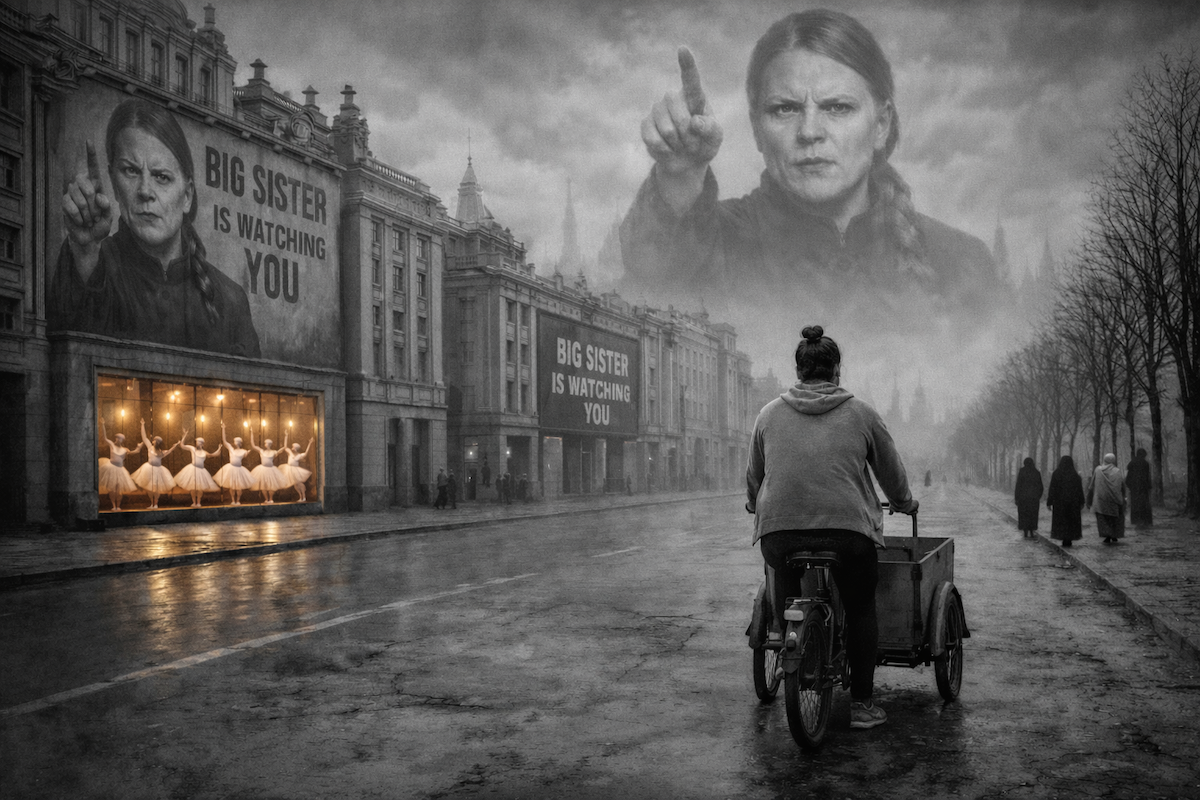
PS: The featured image was created with the help of artificial intelligence. It’s quite remarkable what you can produce when you take the time to craft a fitting prompt. In this case, the prompt was almost a full page long. And of course, the image isn’t meant entirely seriously—it contains sarcastic, dystopian, and certainly provocative elements. But where do we end up if, out of anticipatory submission to (supposed) correctness, we can no longer take aim at precisely these things? In that sense, my images and texts are always intended as invitations—both sincerely meant and deliberately provocative. 😉