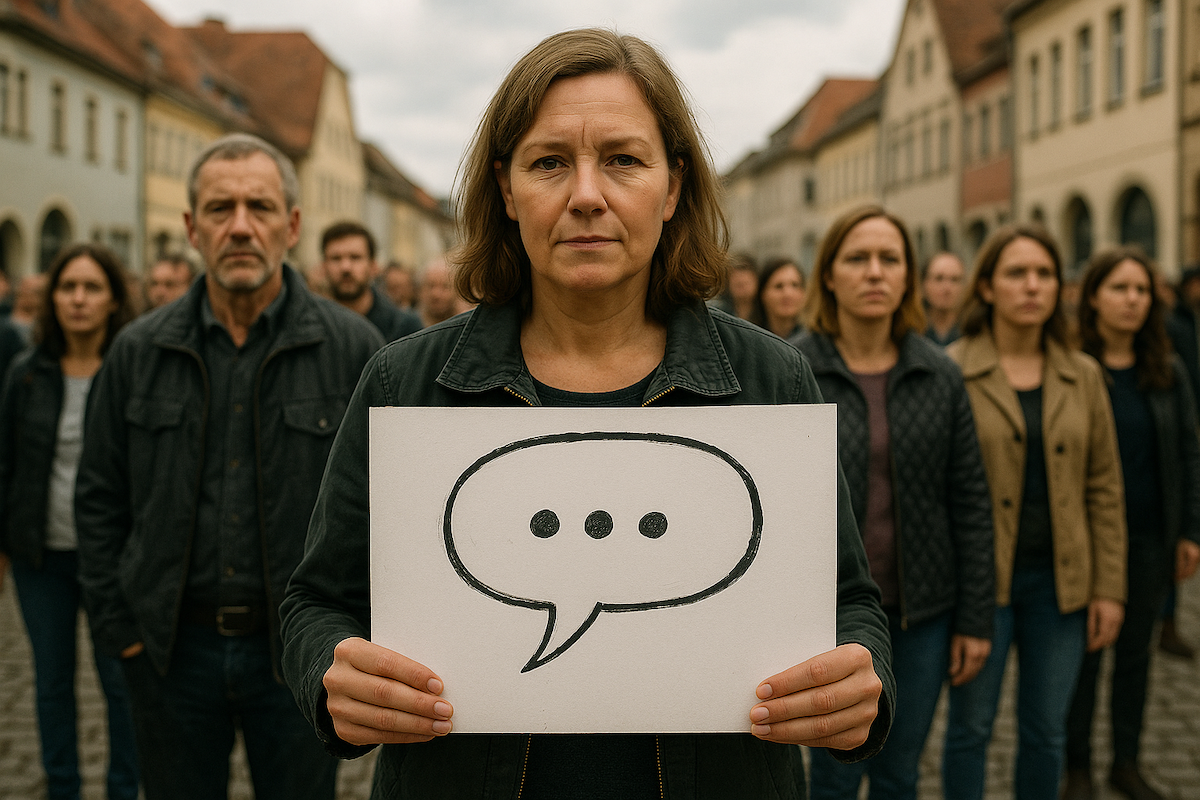
The Almost Inevitable Development Towards “…”
We don’t know what’s coming — that’s why the three dots in the headline are placed in quotation marks: as a placeholder.
What is to come may be unknown to us, but we are already reacting to it as if it were known — using concepts we already know. We think we know. But in reality, there is little we truly “know” at the moment.
Of course, the AfD initially appeared to many of us as unpleasant, radical, hardly electable — but to some of us it already appeared somehow “cool”. The AfD has called itself the “Alternative” ever since it was founded. But at first, it wasn’t an alternative for most people — though over time, it has become so for more and more. And this, I would argue, has less to do with the AfD itself than with the all-too opinion-stable opposing side.
Angela Merkel’s “Wir schaffen das!” (“We can do it!”) has, in hindsight, turned into the starting point of a certain development. At the time, it wasn’t meant as a deliberate beginning, but over time it became one. In the end, “we” didn’t actually “do it” — at the cost of the fact that this “we” no longer exists.
Those who were already skeptical back then became even more skeptical over time — with the consequence of a growing sense of alienation. The AfD’s current success is rooted in skepticism and alienation — and in two experiences:
— that you can vote for whomever or whatever you want, but in a certain sense “things keep going as they are”, and
— that you are also supposed to be persuaded that you are wrong.
Of course, there have been radicalization processes — though on “both” or even “all” sides. Skepticism was not listened to; it was lectured at. The result was reactance — resistance to persuasive pressure. At the same time, politically, very little actually changed, while the economic situation has steadily worsened in recent years.
And even when, more recently, people voted primarily out of concern for the issues of “economy” and “migration”, these concerns were, by and large, given too little consideration — with the consequence that yet another segment of the population is turning away.
“People want something to change. They vote, but don’t feel represented. They see the situation growing more complicated. Pressure is mounting — partly due to global developments, partly due to decisions made in Berlin. They may feel pressure themselves, for example as self-employed people, when political decisions directly or indirectly affect their business situation. They no longer recognize their own country, yet are lectured that they are wrong. They may wonder if they’re still normal: Surely someone must notice what’s happening!”
The lecturing drones on.
Elections produce results — but in the eyes of a growing share of the population, they produce no effect.
People begin to wonder what they should do. It cannot go on like this, they think.
Then, the chairwoman of a political youth organization calls the president of a federal state a “son of a bitch”.
“What gives that young woman the right to say that?” one might ask. But who listens when someone asks such a question?
And so it continues — little by little — until people start voting differently than they ever would have thought possible only a few years earlier.
Until those “others” eventually have the majority.
To avoid any misunderstanding: the “Alternative” will not eventually gain a majority because it is somehow “smarter,” but because, in the eyes of a growing share of the population, it currently appears to be the only political force that can be relied upon not to participate in what voters, in increasing numbers, no longer want.
Later, people will say that we “stumbled” or “slid” into it. And then they will be astonished.
But the fact that this stumbling and sliding will have had something to do with their own self-righteousness — that, they will not know then, and certainly will not want to admit.
Some among us may sense this, but they do not say it — or only whisper it in private. Because if you don’t join in the “firewall choir,” you’re said to be opening the “gates of hell,” you get questioned, or you even run into trouble. And you don’t want that — maybe because you have lectures to give, or because you depend on public funding projects, or because “critical” journalists are only too ready to scrutinize everything you may have said or meant.
Others among us may not want to see it, or may simply be unable to — because their ideals are, after all, the “right” ones. That when ideals drift far enough from reality, wrong decisions are made; that people are sometimes openly threatened or excluded when their views diverge too far from the desired mainstream and remain firm — that cannot be, that does not happen. And if it does happen, it’s merely a “collateral damage”.
The fact that things could eventually turn out this way, of course, will have nothing to do with you personally. You always voted for the “right” side.
The fact that things had to turn out this way, because the “counter-radicalism” of the others blocked any pragmatic, balancing kind of thinking for purely ideological reasons — that won’t occur to you anymore. By then, from your perspective, it will already be too late.
But life goes on.
And those who come too late are punished by life.
PS: The image was created with the help of artificial intelligence.