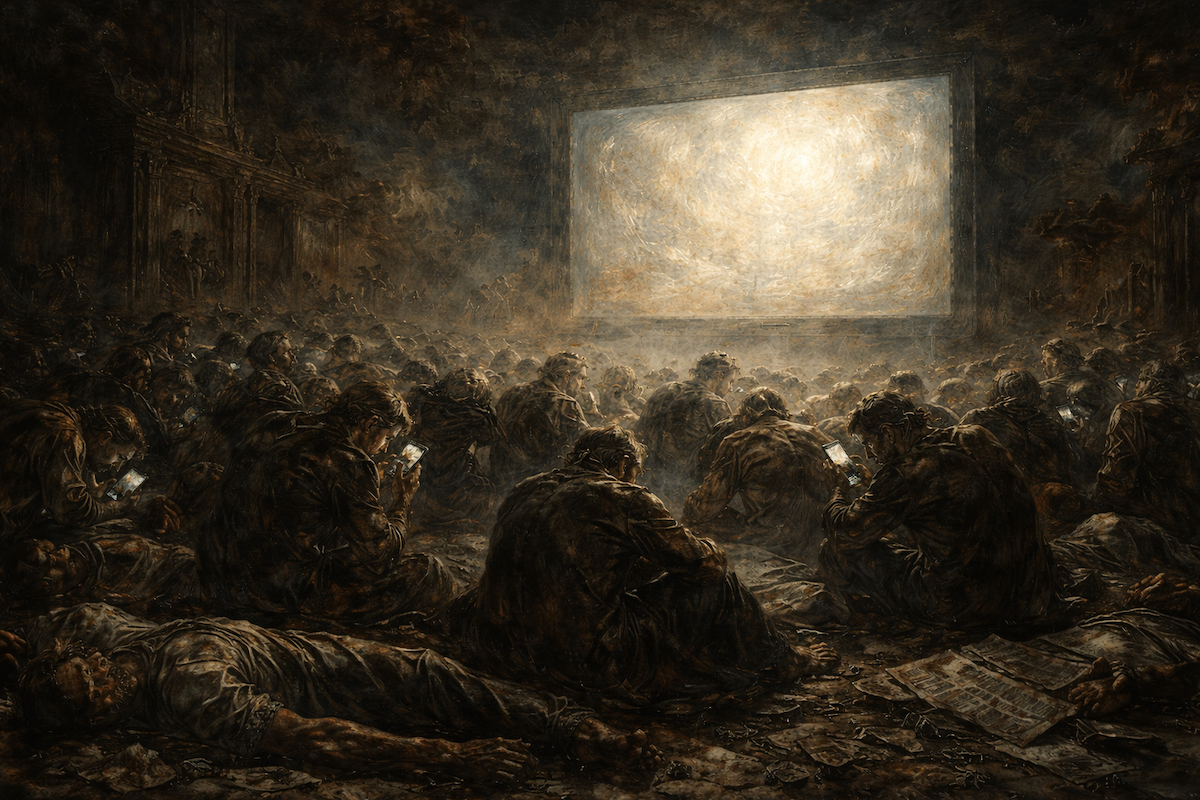
Media Power and the Loss of Reality Reference
A common theory holds that media, on the one hand, depict life, but on the other hand also shape life. Let us take advertising as an example: advertising depicts life and places within that depiction certain products that one is supposed to buy. This does not always work, but it works often enough—otherwise no one would spend money on it. Reality is not only depicted, but is also slightly altered through the projection of new products into it. The aim is that your brain, when you are standing in a supermarket in front of a shelf of otherwise fairly interchangeable products, makes a distinction, so that you choose the product that is most “accessible” to your brain, ideally completely unconsciously. In this respect, this is quite a subtle process. In advertising, it is generally not about you listening or looking closely. It is only about you not switching away. “Listen-throughability,” for example, is a term used by people who work for radio stations. The advertising break should function as well as possible, but not be so annoying that one changes the radio station.
As far as its effects are concerned, it does not always remain so subliminal: not only are existing needs depicted and provided with suitable product responses, but new needs are also created, which may then assert themselves. Thus, for example, the smartphone is not only to be understood as a response to needs that existed back at that time, but also and above all as a project to create an entirely new experience and thus also new needs. Media depict, and something new leans into the picture, almost imperceptibly, as it were; reality changes slowly. Media can also depict something, and this “leaning in” can occur in such a way that the effect becomes epoch-making. The latter is an art for which those who master it are very well paid.
What was initially illustrated here by using advertising as an example also applies to films and series: daily soaps are by no means merely a depiction of reality. The last “average television family” (mother, father, two children) were, in a broad study of characters in series, already in the 2000s … the Simpsons. In GZSZ, at the time, there was not a single “average family”, but all kinds of relationship models and variants of living together. Since the 1990s, it was also observable that the number of friendships among young people declined, while satisfaction with friendships increased. Younger women were all the more satisfied with their friendships the more series, sitcoms, etc. they watched.
These are all developments that were already observable before the emergence of social media.
Conduct an experiment and ask any group of apprentices or students about their role models. In about half of the cases, you will be given series characters or other fictional figures. We replace our friendships with “television friends”. In German television, the Tatort detectives are the most important figures of identification. The birth rate of these figures of identification is so far below 1 that it is not even worth mentioning. Life is not only depicted in series, but also shaped—with corresponding consequences.
Today, more than half of our children are only children.
Something has changed—not only because media have depicted something, but because media have also emphasized something, and because new media were invented that accelerated this process: what counts is not what I want to express, but that which the algorithm recognizes as potentially likeable and further amplifies through likes. With social media, everyone can depict, emphasize, and—interacting with the algorithm—shape. The dynamic diversifies and intensifies at the same time.
One of the prices is a drastically rising loneliness among young people today.
But the matter goes even further. It does not stop at knowing and using the connection just described. They no longer shape reality slowly through the interaction of depiction and imprinting (the process described as subtle), nor do they merely hope for the normative power of persuasion (the smartphone example, that is, using the process, but with significantly greater effect); instead, they come straight on with assertions that are presented as “normal”. This is a more or less “double normativity”: They do not merely use the power of the mechanism itself, but go one step further: they assert a new norm and make it clear that any deviation is “backward”.
This means: it is no longer an interplay of depiction and shaping, but plain instruction. Formally, there should no longer be any difference from what one calls propaganda. One repeats without interruption what one believes to know, and one also knows: repetition is effective—especially when the target persons have no idea. One additionally authorizes certain organizations not only to monitor the matter, but to actively intervene when something is deemed incorrect, and then calls them “trusted flaggers”. And one shows readiness to respond to even the slightest sarcastic disparagement with a complaint. Interestingly, the new old man at the top differs little in this respect from the two green grand ministers from the last government.
A request to those who are old enough to remember—if they do remember, because one must have been involved with the whole matter in order to remember: what was meant by the term “civil society” at a time when there was no civil society may have been something entirely different from the actually existing civil society today.
Just one example: the Greens were once a party that incorporated the aspiration to create peace without weapons into government programs. I myself, personally, may call myself a “specialist in civilian peace service”. I was among the 16 people who were allowed to complete this training as the very first “guinea pigs.” This training program was made possible by the first participation of the Greens in a state government in Germany (in North Rhine–Westphalia under Johannes Rau). At the time, people believed that warlike conflicts, or at least the corresponding tensions before and after wars, could be addressed with communicative means—and they trained people for this purpose. I learned my lessons in conflict processing with communicative means during a three-year foreign assignment in Bosnia and Herzegovina. I subsequently studied communication psychology. For thirty years, I have spent a significant part of my time doing nothing other than dealing with conflicts.
To put it briefly: it annoys me when the doves of peace of that time suddenly become hawks who accuse the new doves of peace (who are now more likely to be found on the political right) of being “proven right-wing extremists.” Something is wrong there. And even if everything were correct and I were mistaken, the concrete question at issue (war or peace in Ukraine) would by no means be as easy to answer as the protagonists like to present it. Of course Russia invaded Ukraine. And if it were up to me, that should never have happened. But in the given world, far too often it is not about what is “right” or “wrong”, but rather about what is “possible”. A war outcome such as the one envisioned by the current Ukrainian president is not possible. The result will be a divided Ukraine, and that was, unfortunately, already clear months ago. One may find this view cynical, and one may find the historical arguments, for example those of Samuel Huntington, abhorrent—but that will change nothing.
As harsh as all this may sound—at this point it becomes clear what we are dealing with.
One notices limits only once one is at them or beyond them. Europe is supporting a war that is just, but lost—because we believe it is about principles. But it is not about that. And even if it were, one should look in the mirror: perhaps this is unpleasant for those concerned, but ultimately it is true—thirty years ago, the principle of the party in question was above all pacifist; today it is different, but in any case the party is about principles! Is that a contradiction? In terms of fervor and didacticism, the said party has at no point slackened.
Back to the actual topic: tolerance is something anonymous, and when it truly is anonymous, it is quite possible to live with it. But when tolerance comes along with an outstretched index finger, when it wants to instruct, when it becomes “importunate”, when it serves up what is to be tolerated on a platter and demands applause—even aggressively demands applause and threatens disparagement if one does not want to clap—well, where are we then?
Only a rogue would now think of the actually existing GDR.
The matter has detached itself from reality. One uses knowledge about the imprinting potential of media to implement a certain target conception of the world. One no longer cares about depictions of the real world. Nor does one ensure that new ideas lean nicely into the picture. The matter has tipped from depiction with transformative potential (the new things lean into the picture) into an assertion—if we only assert long enough and often enough that this or that is the new reality, and if that is depicted often enough even halfway, then that will do—whether it still fits actual reality no longer matters; after all, we know that it is good.
At bottom, this is propagandistic self-righteousness with a quasi-missionary zeal for enlightenment. Pious didacticism, stripped of faith, but clad in postcolonial theories and with a frightfully romantic streak for Islamism and an equally frightful blindness to antisemitism.
We absolutely want to be the good ones, and we know how to do it!
We construct theories that prove to you that our ideas are better. (Please read Habermas and ask yourself how much “protestant-didactic echo” there is in his theories.) The (quiet) self-righteousness has transferred itself from faith to other currents—nowadays above all under the labels “climate”, “diversity”, and “antifascism”. The Protestant churches may no longer have many members, but the zeal lives on—and may become an anchor point for a way of thinking that presents itself as secular, but is nevertheless susceptible to authoritarianisms beneath the surface—a way of thinking that has selected diversity agenda as an identity-forming project as an answer to a “romanticizing idealistic longing”, sporting “inclusive” as well as “Islamistic” motives, without being aware of contradictions or dangers.