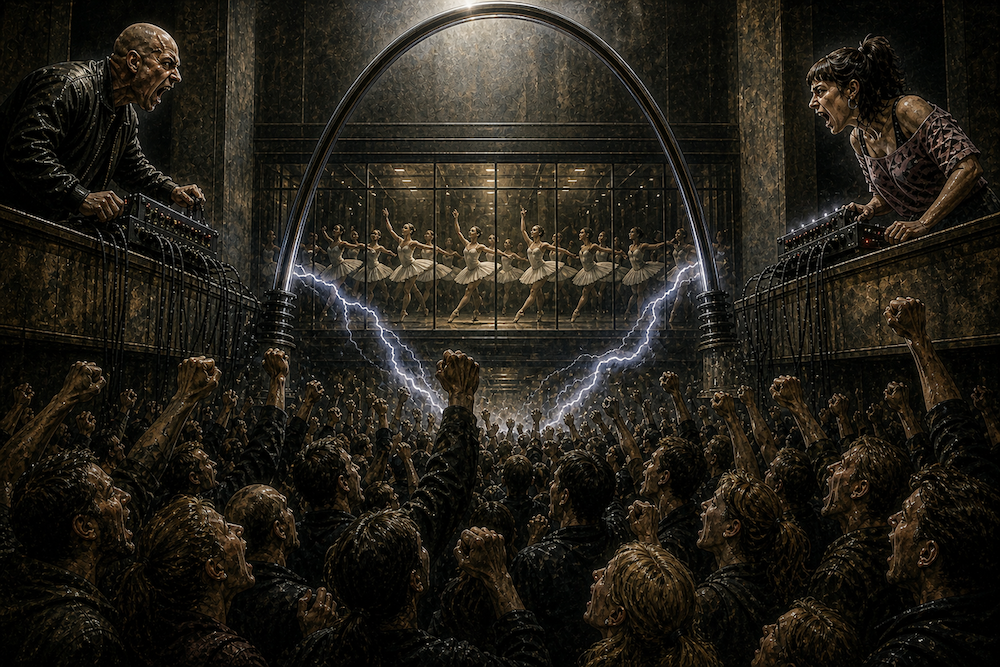
How Dark and Ugly Emotions Return
If you look at the social developments of recent years, it seems impossible to ignore the depth of the divide that has emerged within our societies.
Of course, memory likes to deceive us into believing that things were somehow different “back then” or “when we were young”. Anyone who lived in West Germany should think back to the 1970s. Anyone who lived in East Germany should remember the actual reality of life under constant paternalism and control — not the sentimentalized images produced today when people gather on weekends to take nostalgic rides in old East German vehicles through mild spring weather. They of course can do that. But this kind of projection has very little to do with the reality of the GDR as it actually existed.
Or think of the years after the German reunification. For many people, there was nothing pleasant about that period.
Why am I writing this? Because this is not the first time society has been shaken to its core. For some of us, it may simply be the first time it has happened within one's own lifetime.
What is happening today is certainly intense. But think back to 1989 — to September, when people perhaps only sensed that something might be coming and slowly began to dare a little more, and then to October, when people truly began to take risks, before everything unexpectedly came to a good end in November.
To avoid misunderstanding: today’s situation is entirely different from 1989. But some people will think: no, no, the comparison is not that far-fetched after all. But that is not my point. The comparison merely illustrates that many of us have already experienced what it feels like when an entire society is shaken. Those who remember that time may also remember the uncertainty. At no point could anyone be sure things would work out — not for a single second — until, fortunately, they eventually did.
Today, however, many people seem all too certain that history could repeat itself, that it must never repeat itself, that “never again” is happening now, and that absolutely everything must therefore be done immediately.
To me, that reflects a kind of historical amnesia. The contemporary “right-wing” movement is far more a reaction to present-day developments than an attempt to recreate that former criminal regime. History repeats itself, but never in exactly the same way and never in exactly the same place. Of course there are still a few people trapped in the past. But eighty years after the collapse of the Nazi state, “resistance” has become easy. It costs nothing. It brings applause and likes. And above all, it spares people the burden of forming an independent opinion.
Social developments tend to move in waves, and they are the result of interaction processes. It is not the case that one side is purely “good” while the other side alone has radicalized into something “evil.”
Such interaction processes have been discussed on this blog many times before, so why revisit them? Perhaps because it is worth examining the psychological sharp edges of polarization — not merely what divides us, but the grinding stones that sharpen the axe in the first place.
There are agitators on every side involved.
What matters here is the fury that drives people into the streets. At most, perhaps fifteen percent actually take to the streets — probably fewer. The rest are driven only into anxiety or endless discussion. This text is not about the content of those discussions or demonstrations. It is about what fuels them.
That fuel consists of emotions.
From the perspective of human history, the fact that we are capable of reflective thought at all is relatively new. Consciousness is tied to language; only through language did we acquire the ability to become aware of ourselves. The subconscious, however, has been guiding human beings for far longer. It is older, more immediate, more instinctive in shaping — perhaps even determining — our behavior. Our lives are full of examples in which rational thought would have led us to completely different decisions, had strong emotions not intervened.
Under pressure especially, most people do not act rationally. We make intuitive or impulsive decisions first and then later justify them with elaborate explanations — to ourselves and to others. Theories about “rational discourse,” or even “nonviolent communication” are all very nice. But under pressure, they are often inaccurate descriptions of how human beings actually function.
Civilization requires a certain restraint. The generation that experienced war firsthand understood what happens when restraint disappears. Much of today’s population, it seems, no longer does. We gamble with polarization in a way that should concern us. Where else do the increasingly extreme statements of our own time come from? For example, the idea — now openly voiced by some — that armed force might ultimately be justified in order to prevent a particular political party from winning an election. The last members of the wartime generation have died. With them, a certain restraint died as well. Large-scale wars become possible again only after those who witnessed the last great war are gone. We have long since entered a new reality.
The current polarization is not merely a matter of differing opinions or political preferences. Above all, it consists of emotional intensifications that regard themselves as morally justified or legitimate — and which reinforce one another through mutual reaction and opposition. The supposedly radical reaction of the other side becomes the justification for one’s own escalation.
Recent developments have produced feelings of humiliation, powerlessness, defiance — and eventually withdrawal and cynicism — on one side. Over time, this may even evolve into fantasies of revenge.
On the other side, people believe that history itself places them on morally secure ground. Their own mistakes are either invisible to them or concealed beneath moral fervor. That fervor sometimes grows into something resembling revolutionary enthusiasm and culminates in the deeply emotional conviction not merely of being right, but of standing on the “right side of history”.
While some people leave disgustingly racist comments beneath politically correct Facebook posts, others cry when the former German chancellor repeats “Wir schaffen das” — “We can do this” — at a Christian convention.
Now hold on, some might say. Those things cannot possibly be compared! Of course they cannot. There are differences in the emotional patterns. But this text is about fervor. And fervor can appear both as hot rage and as sacred enthusiasm.
These are the emotional extremes of the spectrum. Though perhaps it is not a spectrum at all, but a parabola whose ends spark against each other. The extremes repel one another, yet are strangely attracted to each other as well, because each side strengthens itself through opposition to the other. Over time they even begin to resemble each other — much like warring parties will grow increasingly alike the longer a war endures.
A cynical side note: one could interpret President Zelensky’s recent warning to members of his own party in a similar light — namely that those who fail to vote “for the state” may soon find themselves at the front.
But back to the sharp ends of the parabola, where the sparks fly: this dynamic is possible in a democratic society, but if it persists for too long, it becomes dangerous.
The current “right-wing” escalation feeds on the impression that people have spent years not being taken seriously, being morally devalued, or politically disempowered. At first this creates skepticism, then opposition, and eventually an emotional hardness that no longer seeks understanding. You can already see it in the way some people react to crises or political failures. It is no longer only about being right. The failure of the opposing side — for example, if the SPD (Social Democrats) struggles to clear the five-percent threshold — becomes emotionally satisfying. Some people no longer want correction or reform. They want the others to fail. And eventually this produces a mindset in which political or social escalation is no longer perceived as a danger, but as a necessary “purification”.
The “left-wing” escalation functions differently on a psychological level, but it is no less emotional. Here, a kind of “moral transcendence” emerges. People begin to see themselves as participants in a historical project: migration, climate activism, diversity, anti-discrimination, the fight against the right wing movement. These causes are no longer merely political positions; they become emotionally internalized identities. The result is a feeling that can take on almost religious dimensions. People are no longer merely protesting. They experience themselves as part of the supposedly “good” side. And like every strongly moralized worldview, this form of self-affirmation gradually produces growing intolerance toward deviation.
The more moralizing one side becomes, the more the other experiences it as condescension and coercion. The more aggressive the reaction becomes, the more confirmed the morally charged side feels in its worldview. Both sides stabilize and intensify each other. The radicalization of the other side becomes the justification for one’s own further escalation.
This dynamic can be observed particularly clearly in debates surrounding migration policy.
A purely rational discussion would theoretically be possible. One could ask: how many people can a country realistically integrate? What consequences emerge for housing markets, schools, public safety, welfare systems, and cultural cohesion? What economic advantages and disadvantages might arise? What risks accompany them? What distinctions should be made between qualified immigration, asylum, and uncontrolled migration? What integration capacities actually exist in practical terms — not morally, but concretely?
Not to mention the questions that ought to be obvious: what kind of migrants do we actually need? How can we become attractive to them? How should migration be organized in a way that serves society? And how much additional migration do we want — and under what framework?
Since the moment “Wir schaffen das” (“We can do this”) entered public discourse, precisely this kind of rational differentiation has largely disappeared. Simply making such distinctions is often labeled “racist” by those who dominate the discourse.
Any rational criticism is quickly interpreted as a moral attack, while humanitarian arguments are increasingly dismissed by the other side as “naive” or “ideological”. The debate thus shifts away from practical judgment into the realm of identity. People are no longer merely discussing migration. They are defending their own self-image.
Concepts such as “proportionality” or “appropriateness” now lie metaphorically “dead in the field”. The pragmatic counterpart to the statement “We can do this” — namely the question of what exactly we want to do, and why — has become nearly impossible to ask, even though that may have been the most necessary question of all.
People no longer distance themselves from one another merely through arguments, but emotionally. The value of one’s own position increasingly derives from the certainty that it stands in opposition to the other side. Emotional impact no longer arises from a shared effort to preserve the common good or secure a common future, but from the most symbolic, forceful, moralizing, or cynical possible display of difference.
People do not receive likes for the more thoughtful argument — and certainly not for attempts at reconciliation — but for the loudest, harshest, most emotionally charged forms of denunciation, moralization, or total rejection. Everyone retreats into their own echo chamber. Everyone lives inside their own bubble of confirmation. And this constant questioning, carried out solely to reinforce one’s own position, gradually undermines what we as a society share, the “common ground”.
For the most part, this is both unconscious and opportunistic. We do it because it works. We may not intend harm, but we accept the consequences because otherwise we would receive less attention, less affirmation, less resonance. Social media rewards almost everything except restraint. Yet restraint is precisely what would help.
The proverbial cat begins to chase its own tail. A spiral of escalation emerges. Every provocation justifies the next provocation from the other side. Every boundary crossed by one side becomes the moral justification for crossing boundaries on the other side.
And this does not remain without consequences.
Once political opponents are no longer seen merely as people who are mistaken, but as traitors, fanatics, or enemies, the threshold of legitimacy surrounding violence begins to shift. Violence does not begin only when someone throws a punch. It begins the moment people inwardly accept escalation.
And that is already visible.
It can be seen in the quiet satisfaction people feel when political opponents are attacked. It can be seen in the tendency to relativize crimes when they affect the “right” targets. It can be seen in the growing willingness not to clearly reject intimidation, social destruction, or physical assault, but instead to explain them psychologically — and thereby implicitly excuse them.
And this is happening on all sides involved.
Some openly or covertly fantasize about “resistance” against what they perceive as an authoritarian system. Others speak in quasi-revolutionary language about having to prevent certain political developments “by any means necessary.” Both sides believe themselves to be acting defensively. Both believe they are merely responding to a threat.
And therein lies the danger. Escalations rarely occur because one side suddenly becomes “evil”. Escalations arise because political interaction processes gradually intensify emotionally over many years until, at some point, people stop perceiving the other side as part of the same community.
The problem is not polarization itself. The problem is the gradual disappearance of the inner boundary that once prevented people from viewing political opponents as legitimate objects of hatred, humiliation, or violence.
Positions drift so far apart and become so incompatible that hatred itself comes to feel legitimate — that the death of someone from the opposing camp begins to feel emotionally satisfying.
We have already reached that point.
There is little point in offering evidence for it. The radical extremes on both sides dream of violence — or, if not openly dream of it, at least quietly accept that something terrible may happen to “the others.” On both sides, the essential precondition for totalitarianism is beginning to emerge: dehumanization.
Some march alongside Hamas. Others announce that they intend to “give German children” to extremist women on the opposing side.
Find the flaw.