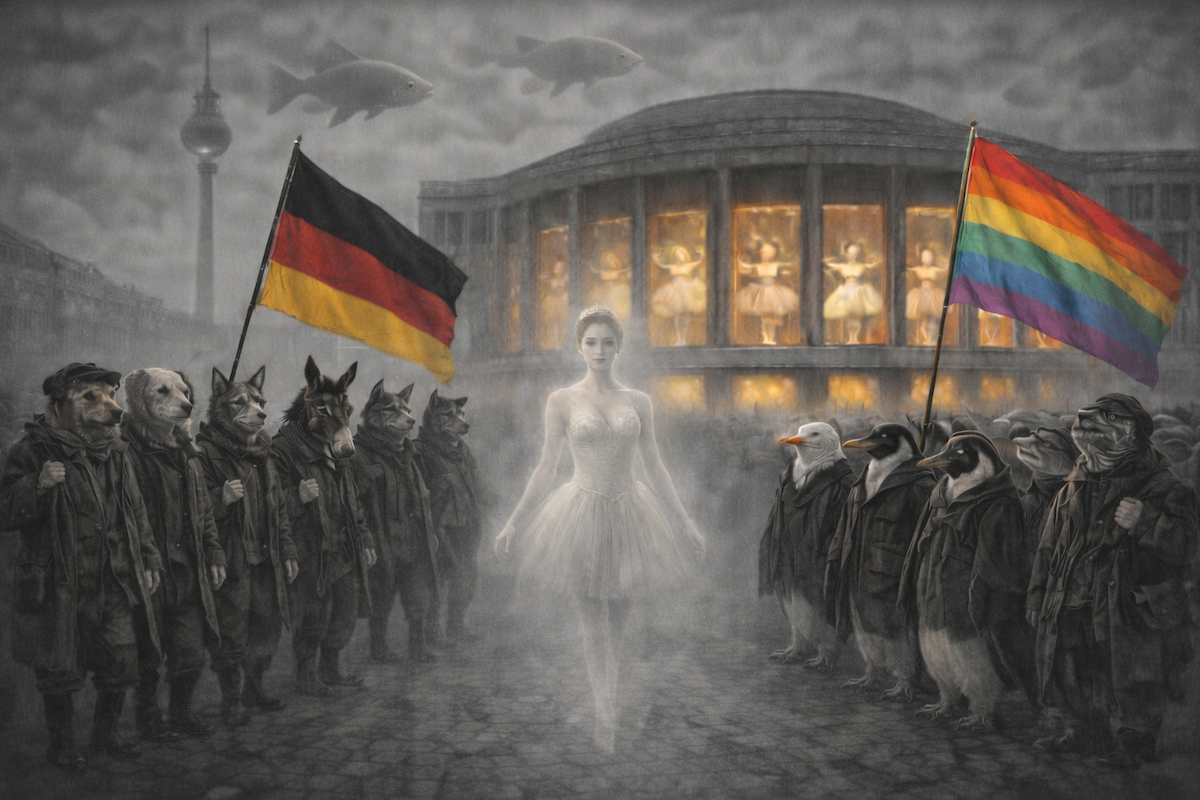
Democracy — But Which One?
The current political polarization in Germany may be understood less as a conflict between parties or political goals, and more as a conflict between different ideas of what democracy actually means.
We talk about democracy — yet we may be referring to entirely different things. We use the same word, but we probably connect it with different political logics. From this difference, if it indeed exists, a kind of communication breakdown emerges that becomes increasingly visible in political debates. People argue with one another, but they are probably not talking about the same thing.
From this situation arise mutual accusations. One side sees in the other’s understanding of democracy a development toward “socialism.” The other side sees in the first side’s understanding of democracy a tendency toward “fascism.”
At first glance, such accusations may appear exaggerated. Yet they do not emerge out of nowhere. They arise from different political ideas about what democracy actually is, what it should accomplish, and where its limits lie.
If one looks more closely at these ideas, three different understandings of democracy can be distinguished that currently exist side by side.
1. Democracy as the Principle of Majority Rule
The first understanding of democracy is relatively simple. Here, democracy primarily means: the majority decides. Whoever is elected and gains a majority governs. Whoever loses an election no longer governs and moves into opposition. The political direction can change with every election.
In this understanding, political change is not a problem but a normal element of democratic processes. Over time, democratic societies move between different political priorities. Sometimes economically liberal programs dominate, sometimes social policies, sometimes conservative agendas.
This understanding assumes that political competition itself is a stabilizing element of democracy. Political majorities shift; parties or coalitions alternate in power.
Democracy lives from the fact that political directions can change. From this perspective, irritation arises when election results have little political consequence. When political constellations emerge in which certain political options remain permanently excluded (“firewall politics”), the impression easily arises that elections do take place — but that their outcomes have only limited consequences. At that point, part of the population begins to doubt whether democratic processes still produce the effects people expect from them.
2. Democracy as a “Liberal Balance”
A second understanding of democracy expands the majority principle with a certain limitation. Here as well, majorities decide the dominant political direction. At the same time, there exists a legal framework that guarantees individual freedoms and protects certain — legally defined — minorities to some degree.
This model corresponds to the classical liberal understanding of modern democracies. Majorities can make political decisions, but they cannot decide everything. Fundamental rights and constitutional institutions set boundaries.
Within this model, the state organizes a certain redistribution through social security systems. At the same time, individual freedom of expression and economic activity remain largely unrestricted.
The state intervenes in a corrective manner, but it regulates the dynamics of economic processes only sparingly — and certainly not the dynamics through which political preferences themselves evolve. Political reforms adjust the balance between social protection and economic freedom without fundamentally questioning the structure of the system.
For a long time, this model enjoyed broad social acceptance because it combined several principles: freedom of expression, economic productivity, and social stability.
3. Democracy as a “Progressive” Project of Diversity-Oriented and Climate-Oriented Responsibility
In recent decades, however, a third understanding of democracy has developed. With this perspective, the center of gravity has shifted. No longer the majority decision, nor the balance between freedom and minority protection, stands at the center. Instead, the focus lies on the inclusion of as many social groups as possible.
The protection of minorities is no longer understood merely as protection against discrimination; it is increasingly interpreted as the active compensation of disadvantages. Political measures are meant to reduce “structural” inequalities and provide equal access to opportunities for different groups.
At the same time, society is expected to take responsibility for human-induced climate change. In this logic, “liberal equality before the law” is no longer sufficient. What now matters is the reduction of disadvantages — and the transformation of society in ways that produce as few climate consequences as possible, and progressively fewer over time.
This inevitably leads to a stronger role for the state. The state organizes redistribution — through programs that support certain disadvantaged groups and through measures aimed at reducing social inequalities and limiting harmful impacts on the climate.
Politics thus gradually shifts away from the question of how to design a liberal framework for economic performance and the prosperity that follows from it — and toward the question of how existing resources should be distributed fairly.
What exactly counts as “fair,” of course, is itself fiercely contested — ranging from demands for voting rights for refugees on one side to the sentiment “Take care of us first before you try to save the world!” on the other.
Mutual Misunderstandings
The problem arises where these different understandings of democracy — particularly the first and the third — collide.
From the perspective of the simple majority model, the progressive understanding of democracy appears as an expansion of state intervention (redistribution and regulation). In this view, the state becomes the central organ of social organization — or even a kind of “central authority,” depending on perspective. Some observers see in this development echoes of historically more state-centered forms of political organization that have existed on German soil.
From the perspective of the progressive understanding of democracy, however, the simple majority model appears risky. If majorities can decide without normative limitations, the concern arises that minority rights could be weakened or that social progress might be reversed. Whether the developments often described as “social progress” actually deserve that label is itself, of course, highly disputed.
Thus a situation emerges in which both sides attribute fundamental dangers to the political approach of the other.
Some see in the current political trajectory a movement toward socialism. Others see in calls for stronger majority rule a possible opening toward authoritarian politics — or even fascism.
Whether the real politics of recent years — beginning with the “We can do this” moment in 2015, continuing through pandemic policies and various climate-related legislative initiatives, and extending even to the fact that police may in some cases now knock on your door if you publicly mention certain politicians’ names in temporal proximity to certain perhaps otherwise fairly harmless insults — might themselves have displayed certain authoritarian tendencies remains, unsurprisingly, a contested question.
The Psychological Dynamic
These different perceptions do not remain without consequences for the political mood. When a growing number of people begin to feel that election results have limited or no political consequences, the first reaction is skepticism.
Skepticism can turn into rejection. Rejection can turn into reactance — a psychological resistance against perceived pressure to adopt certain views. The result: people begin to do the opposite of what is expected of them.
If nothing changes, reactance may evolve into fatalism. People withdraw internally and assume that political participation makes little difference anyway.
From fatalism there may eventually arise something like “civil burnout” — a state in which confidence in the basic functioning of the political system is fundamentally lost.
In such situations, a paradoxical dynamic emerges: people support political forces that promise radical change not necessarily out of conviction, but out of the feeling that there is nothing left to lose anyway.
The Quiet Erosion
The current political divide runs less between parties than between different ideas of what democracy should be.
On one side stands a political milieu that sees the expansion of inclusion, minority protection, and state regulation as the necessary further development of democratic societies.
On the other side stands a milieu that increasingly feels that economic productivity, individual freedom, and democratic majority decisions are being constrained.
Both sides speak about democracy.
But they are speaking about different models of democracy. As long as these differences are not clearly named, political communication will remain distorted. The participants use the same word but attach different political meanings to it. What for some appears as the defense of democratic core values appears to others as a restriction of democratic decision-making.
Democracies rarely lose their stability suddenly. What they lose first is the taken-for-granted assumption, in the eyes of their citizens, that the system still functions.
That point, I would argue, we have already passed.